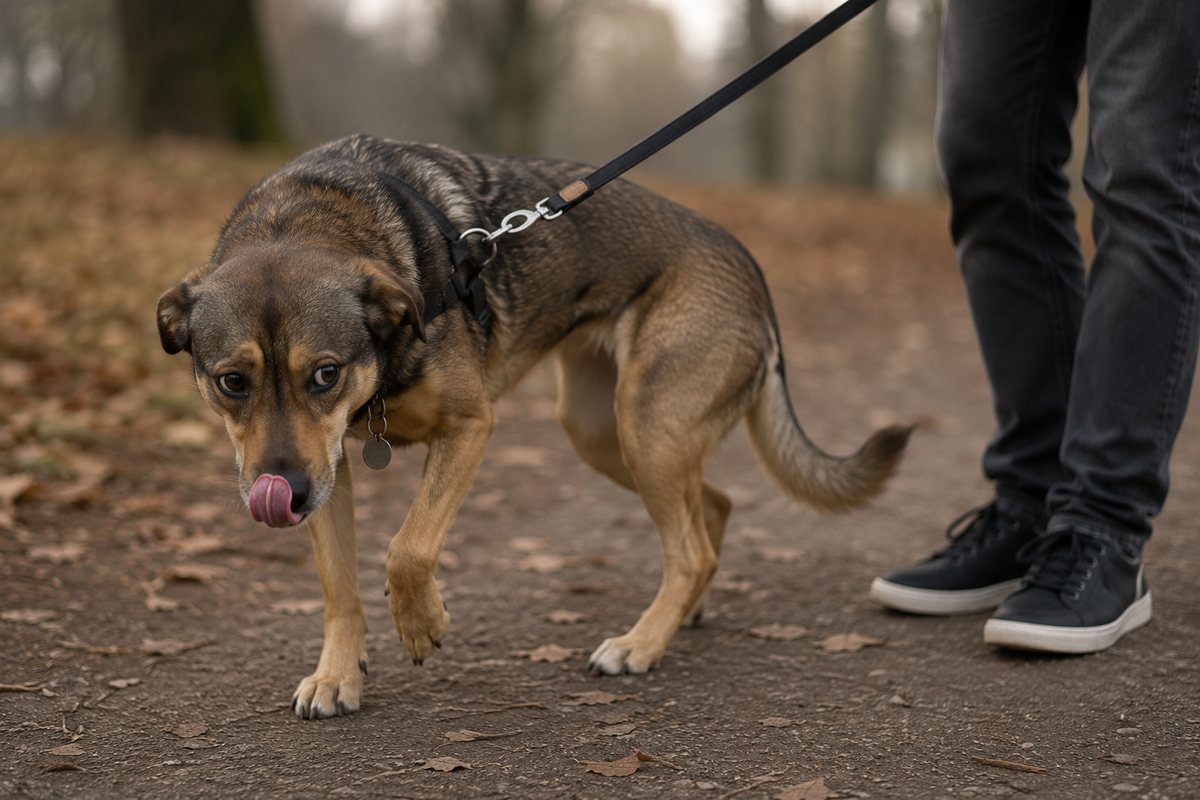
calming signals – in the English original calming signals – are among the terms that have changed how our society sees dogs over the past twenty years. Suddenly, it was clear: dogs communicate. Not loudly, not in words, but through subtle gestures – turning the head away, blinking, licking the nose, moving in an arc to avoid a direct dog encounter. Once you have seen this, you see your dog differently.
At Vitomalia, we encounter the term every day – in consultations, in courses, in comments under Reels. And we notice: there are few concepts that have created so much good and so much confusion at the same time. That is why we want to take a careful look at what calming signals can do, where their limits are, and what current behavioral research says about them.
What Turid Rugaas actually observed
The Norwegian dog trainer Turid Rugaas systematically observed dogs in different situations in the 1980s and 1990s. These observations led to her 1997 book On Talking Terms with Dogs: calming signals, which was republished in a revised edition in 2006. In it, Rugaas described around thirty gestures that she repeatedly saw in conflict situations: turning the head away, narrowing the eyes, yawning, walking slowly, moving in an arc, sitting, lying down, sniffing, licking over the nose, lifting a paw.
Her core idea: these signals serve de-escalation. Dogs use them to calm themselves, reduce tension in an encounter, or prevent a conflict from arising in the first place. Rugaas' contribution lies in having shown dog owners and trainers that this quiet level exists at all. Anyone who previously only reacted to growling and barking was almost inevitably too late.
Why this shift in perspective was so important
In a dog world that had, for decades, primarily thought in terms of dominance, obedience, and hierarchy, Rugaas' approach was almost revolutionary. Suddenly, the key question became: what is the dog actually saying before he “does not function”? This shift – away from correcting end-stage behavior and toward reading early signs – has strongly shaped modern dog training.
Vito is a dog whose facial expression we can now read like a familiar book. When he turns his head slightly to the side and blinks briefly during an encounter with an unfamiliar male dog, we know: he is managing it himself; we do not need to intervene. This exact trust in our own dog would probably not have developed without the perspective initiated by Rugaas. In that sense: yes, the concept has moved us forward as a dog community.
What research says today – and what it does not
But if Rugaas' observations are viewed as a scientific theory, the picture becomes more nuanced. Behavioral research over the past two decades has confirmed individual aspects, put others into perspective, and raised several open questions. It is worth taking an honest look here.
This is an important distinction. Mariti et al. show that there is a repertoire of tension, stress, and appeasement behavior – but precise scientific language speaks here in terms of probabilities, not fixed meanings. A dog licking his muzzle can signal stress. But he may also have just eaten or be processing scent.
Communication is multi-channel
A second important line of research comes from Marcello Siniscalchi and his team. In a widely cited review in Animals (2018), they describe that canine communication takes place on at least four channels at the same time: visual (body posture, facial expression, tail), acoustic (barking, growling, whining), olfactory (scent, pheromones), and tactile. The authors emphasize that each individual signal can only be meaningfully interpreted in interaction with the other channels.
This is exactly where one of the weaknesses of many simplified calming signals guides lies: they reduce a complex, multi-channel system to a catalog of isolated gestures. The dog is treated as if he had a vocabulary like a sign language – with clear word meanings. That does not do justice to reality.
What Beerda and Bradshaw contributed
Bonne Beerda and his research group began measuring stress in dogs physiologically as early as the 1990s – through cortisol in saliva, heart rate, and behavior under standardized stressors. These studies produced the now widely accepted finding that certain behaviors – frequent licking, lifting a paw, shaking the body, panting without heat load – correlate with elevated stress parameters. This is the physiological anchor that gives substance to some calming signals observations.
John Bradshaw, long associated with the University of Bristol, has repeatedly emphasized in his work on the dog-human relationship: canine communication is not rule-based like a language, but strongly context-dependent and individual. One and the same dog may react differently in two very similar situations – depending on previous experience, current condition, and relationship to the other individual. Bradshaw warns against reading body language as a deterministic system.
Where the research has gaps
As valuable as these findings are: to this day, there is no systematic, replicated study that precisely examines Rugaas' original catalog of about thirty signals. Individual gestures – licking, turning away, moving in an arc – are well researched. Others – such as “placing oneself between two dogs” (splitting) – still rely predominantly on observational knowledge. That is not wrong, but it is not a completed scientific framework. Anyone who presents the concept as if every single gesture had been empirically validated is going too far.
Where overinterpretation begins
This is precisely our main concern in daily consulting: in practice, calming signals are often applied too rigidly. We see dog owners who read every lick over the nose as stress. Every turn away as appeasement. Every yawn as overwhelm. The result is not rarely a permanently anxious dog owner who constantly wants to “rescue” their dog – and in doing so interrupts training situations in which the dog was actually completely composed.
A dog may sniff because he is gathering information. He may sniff to remove himself from social pressure. He may sniff simply because something interesting smells there. Without the context – situation, distance, trigger, history, body tension in the rest of the body – the individual gesture is not enough.
Why context changes everything
An example from our everyday life: Amalia, our American Pit Bull Terrier female, often licks her muzzle when she is working with focus. In the classic calming signals catalog, that would be stress. In her case, it is actually concentration behavior – she does it during scent games just as she does during calm chewing sessions. If we read the behavior as stress, we would interrupt exactly the situations that are clearly good for her.
Vito, by contrast, same breed type, same family, shows tension very differently: he becomes very still, fixes briefly, and his lips become ever so slightly tense. Muzzle licking almost never appears in him as a stress signal. Two dogs from the same breed group, with partially overlapping genes – and yet completely different language. This is not an exception; it is the rule.
What this means in practice
In our consulting practice – especially with listed dogs, whose owners are often already under pressure to be observed – we work with a principle we call pattern recognition in context. Instead of a table of “signal X = meaning Y,” we look at four levels at the same time.
First: the dog’s basic emotional state in this situation. Loose, upright, soft? Or tense, making himself small, frozen? Second: development – is the tension increasing, decreasing, or staying the same? Third: trigger – what is happening in the environment right now? Fourth: individual language – how does this specific dog show stress, how does he show concentration, how does he show joy? Only from this overall picture does an individual gesture become interpretable.
Notice early warning signs – without overloading them
Despite all necessary differentiation, the overarching principle remains correct and important: read dogs early, take early signs seriously, and do not wait for loud behavior. If you know your dog and perceive his individual quiet signs, you can prevent many escalations before they develop. That is the lasting value of Rugaas' work.
At the same time, this applies: this sensitivity should create room for action, not fear. A dog owner who reads and understands their dog becomes calmer – not more anxious. If, in everyday life, the concept leads someone to perceive their dog only through the lens of possible stress signals, something has gone wrong in its application.
Our Vitomalia conclusion
For us, calming signals are a door opener, not a dictionary. Turid Rugaas showed an entire generation of dog owners that dogs communicate quietly – and that it is worth listening. This contribution remains, regardless of how many individual gestures have today been scientifically validated in exact terms.
At the same time, we see the limits: the concept does not work as a rigid symbol mapping system. Research – from Mariti through Siniscalchi to Bradshaw and Beerda – clearly shows that canine communication is multi-channel, context-dependent, and individually variable. A gesture rarely has one single meaning; it has a probable function within an overall picture.
For our work with Vito, Amalia, and the dogs in our consulting, this means: we use the vocabulary of calming signals as an aid to observation, not as a translation machine. We train dog owners to read their specific dog – not “the dog” from a book. And we remain skeptical of any source that claims canine body language can be pressed into a table.
If you truly want to understand dogs, there is no way around patient, individual pattern recognition. calming signals can sharpen your eye – but they do not replace what ultimately matters: the relationship with this one dog right in front of us.