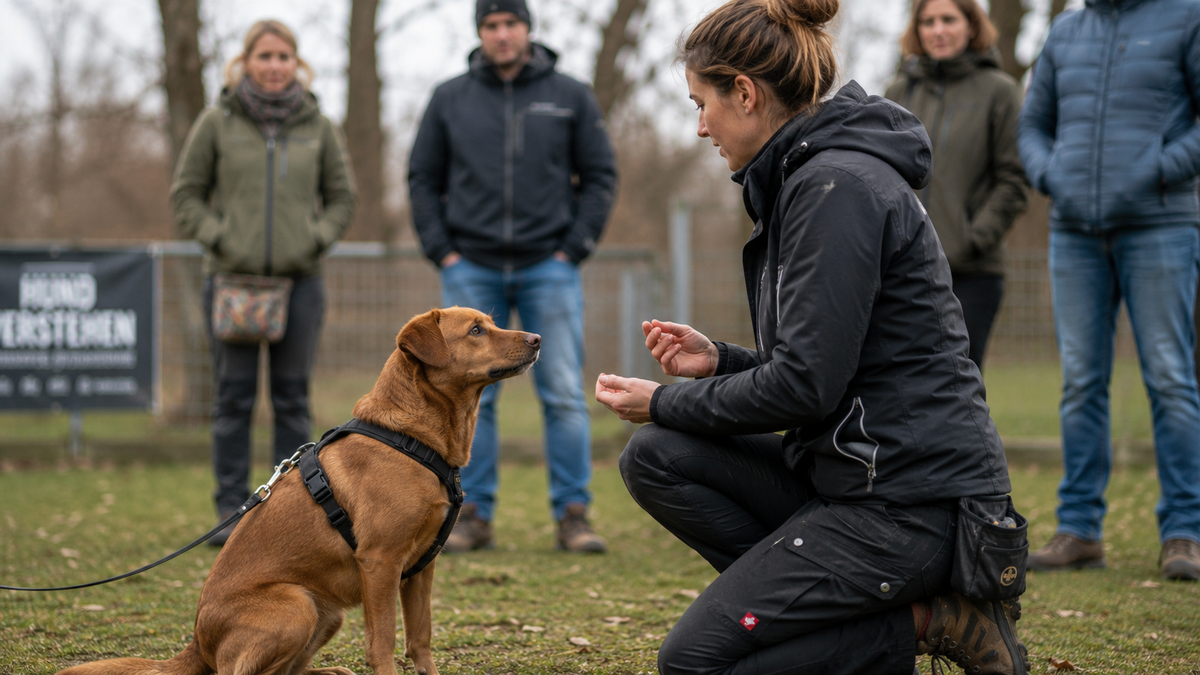
Der Hundetrainer-Markt ist nicht reguliert. Wir zeigen, was Paragraf 11 wirklich heißt, woran wir fachliche Qualität erkennen und welche Warnsignale ernst zu nehmen sind.
Anyone looking for a dog trainer today is entering a market with no clear front door. In Germany, there is no state-regulated training program, no protected professional title, and no nationwide quality assessment. Anyone who obtains the required competency under Section 11 of the Animal Welfare Act and registers their business may call themselves a dog trainer. This is exactly where the problem begins for dog owners who are looking for genuinely competent help.
We see this almost every day in our own work as a behavioral therapist and canine scientist. People come to us after already trying two, three, or four trainers. They tell us about flashy promises, methods that went against their gut feeling, and dogs whose behavior worsened instead of improving. This article is intended to provide orientation. We explain what the legal situation really means, how to recognize professional quality, which methods are supported by science, and which warning signs should be taken seriously.
Why the dog training market in Germany is not regulated
The key point first: in Germany, dog trainer is not a protected training profession. There is no binding curriculum, no state examination board, and no defined minimum number of training hours. What does exist is a licensing requirement under Section 11 of the Animal Welfare Act for commercial training. This license is assessed by the responsible veterinary authority based on proof of competency, usually through a combination of an expert interview and a practical demonstration. The content and depth of this assessment vary from one federal state to another, and sometimes even from one authority to another.
Section 11 is a minimum threshold, not a quality seal
We emphasize this deliberately: having a Section 11 license means that someone has passed the official minimum threshold. It does not mean that this person works according to current scientific standards, is skilled in behavioral diagnostics, or uses animal welfare compliant methods. The minimum threshold is exactly that: a threshold, not the summit cross. Anyone looking for quality in the dog world needs to see this threshold as a starting point and look beyond it.
What associations offer and where their limits lie
Professional associations such as the BHV (Professional Association of Dog Educators and Behavioral Consultants) or the IBH (International Professional Association of Dog Trainers) have their own admission criteria and method standards. Membership in an association is a useful signal because it usually requires verified basic training, regular continuing education, and a methodological commitment, for example to the LIMA principle. But it does not replace your own careful assessment. Even within recognized associations, there are differences in experience, specialization, and personality.
Methods under scrutiny: what science says today
Over the past two decades, scientific behavioral biology and veterinary behavioral medicine have defined a clear corridor. Training based on learning psychology, built on positive reinforcement and a precise marker signal, is now the standard against which every method must be measured. Professional organizations such as the AVSAB (American Veterinary Society of Animal Behavior) and the ESVCE (European Society of Veterinary Clinical Ethology) have published clear position statements on this.
The LIMA principle as an ethical compass
LIMA stands for Least Intrusive, Minimally Aversive. It is not an advertising slogan, but a methodological step-by-step model. Before unpleasant stimuli are even considered, management, medical clarification, meeting the dog’s needs, learning history, and positive reinforcement must be assessed systematically. Every good trainer can explain this step model and apply it to specific cases. Those who cannot often have a methodological gap.
Why dominance theory no longer holds up
The old idea that dogs challenge us hierarchically and that humans must permanently be the pack leader is considered outdated in modern behavioral biology. It is based on observations of artificially assembled wolf groups that do not reflect the behavior of natural family groups. In its position statement on dominance theory, the AVSAB made it clear that dominance-based training approaches often do not solve behavioral issues, but intensify them and increase the risk of aggression escalation.
Punishment, correction, tools: where the red line is
Learning works biologically through consequences; that is undisputed. The crucial question is not whether there are consequences, but how they are applied. Calm limitation, a clear interruption cue followed by an alternative, and consistent management are part of sound work. Harsh tools that cause pain, fear, or shortness of breath are something else entirely. Prong collars, choke leads with a stop function used purely to inflict pain, and electric shock devices are prohibited under animal welfare law in Germany. A trainer who promotes such tools is working neither within the legal standard nor the professional standard.
Quality signals: how we recognize good trainers
When we advise dog owners, we give them concrete assessment criteria. This list has developed from years of practical experience and from our network with veterinarians and behavioral medicine specialists.
Professional substance and continuing education
We ask about the trainer’s education and training background. Where did they learn, over what period, with what in-person components, and with what examination? We pay attention to regular continuing education, ideally in the areas of learning behavior, ethology, stress physiology, and behavioral medicine. Someone who has been training for ten years without any recognizable updating of their knowledge rarely has today’s standards in their toolbox.
Diagnostics before method
With behavioral concerns such as leash aggression, noise fear, separation stress, or resource conflicts, the order matters. First history-taking, then differential diagnosis, then a plan. A good trainer asks about sleep, nutrition, exercise, medical history, previous learning history, and actively refers the dog for veterinary assessment if pain or organic causes are suspected. Anyone who immediately sells a method without this foundation is skipping a crucial step.
Transparency and reflection on methods
Good professionals can explain why they do what they do. They do not use learning psychology terms as buzzwords, but apply them accurately. They also state what they do not do and why. They recognize the limits of their field and cooperate with veterinarians, behavioral medicine specialists, and, where appropriate, other trainer colleagues with different specializations.
Red flags: when we advise against it
Just as important as the question of how to recognize good trainers is the question of warning signs. In our consultations, we have seen recurring patterns that we want to name openly here.
Blanket promises and healing rhetoric
Statements such as “We solve every aggression problem in five hours,” “Guaranteed loose-leash walking after three sessions,” or “Every dog becomes obedient with us” are problematic from a credibility standpoint. Behavior is a complex biopsychosocial system, not a fixed-price repair job. Anyone making blanket promises ignores the dog’s individuality.
Dominance rhetoric and harsh tools as standard
If terms such as “alpha,” “convincing the pack leader,” or “The dog has to feel who is in charge” dominate the initial consultation, or if prong collars, choke collars, or simulated punishment devices are presented as standard equipment, a high level of methodological caution is needed. The same applies to methods in which dogs are deliberately pushed beyond their stress threshold, known as flooding.
Lack of diagnostics in behavioral cases
If a trainer immediately prescribes a method without taking a history, without asking about health history, and without observing the dog in the relevant situation, the professional foundation is missing. Behavioral concerns can have pain-related causes, hormonal factors, neurological issues, or nutritional influences. Taking these into account is not optional.
No willingness to cooperate
A good indicator: how does the trainer respond to the wish to involve a veterinary behavioral assessment or obtain a second opinion? Anyone who blocks this or ridicules it has a problematic professional self-concept. Good professionals welcome cooperation because they know that no one can know everything.
Special case: restricted breed dogs and challenging dogs
We receive many inquiries from owners of so-called restricted breed dogs, meaning dogs that are listed as dangerous in individual German federal states. Here, the issue of quality becomes even more important because legal requirements, temperament tests, and official procedures come into play. Our own experience with Vito and with Amalia, who came to us at six months old, has shown us how much care these dogs deserve and how harmful it can be when they end up with dominance-oriented trainers.
With bull-type, strong, or reactive dogs, trainers need demonstrable experience in this field, calm confidence, clean application of learning psychology, and an understanding of the local legal framework. The idea that a strong dog has to be “handled more harshly” is not only professionally wrong; it is relevant to animal welfare and risky from a safety perspective. Confidence comes from competence and relationship, not from pressure.
The initial consultation as a qualification filter
We recommend deliberately treating the initial consultation as a two-way selection process. What questions does the trainer ask? What statements do they make about methods, tools, and the expected duration of success? How do they speak about the dog, about previous training, about colleagues? How do they respond to questions about studies, animal welfare law, and LIMA? A good initial consultation leaves room for skepticism and answers it calmly.
Our Vitomalia conclusion
The German dog training market is not regulated. Section 11 of the Animal Welfare Act is the legal minimum threshold, not a quality seal. Anyone looking for professionally sound help needs to assess several levels: education and continuing education, methodological positioning within the LIMA corridor, diagnostic care before choosing a method, transparency in explanations, and willingness to cooperate with veterinary medicine. The warning signs are just as important: blanket promises, dominance rhetoric, harsh tools as standard, and missing diagnostics.
This is the line we follow at Vitomalia. We see our role not only as a provider of well-designed equipment, but as a source of knowledge for dog owners seeking professionally sound orientation. Lui, as a qualified canine behavioral therapist, and Paulina, as a canine scientist with an educational and psychological background, bring the dual professional perspective this topic deserves. We believe that dog owners with good information make better decisions, not only for their dog, but also for their own relationship with them.
For anyone currently searching, we want to offer a simple guiding principle: a good dog trainer does not make the dog more functional, but more understandable. If, after a conversation or a session, you feel that you understand more about your own dog, that is a good sign. If the impression remains that something in the dog needs to be “repaired,” it is worth taking a second look. Behavior is communication. Trainers who take that seriously are the right choice.