Welpenkauf ist ein emotionaler Moment. Wir erklären, woran problematische Vermehrung erkennbar wird und warum frühe Aufzuchtbedingungen das spätere Hundeleben massiv prägen können.
The moment we decide to get a puppy is emotionally charged. That is exactly what makes it vulnerable to systems that work with cuteness, availability, and staged closeness—while consistently hiding origin, rearing, and health. In our daily work with behaviorally challenged dogs, we often see the consequences of these decisions only months or years later: as insecurity, as reactivity, as separation anxiety, as arousal that is difficult to regulate. And in a surprisingly large proportion of these cases, the origin lies not in training, but in the first weeks of life.
When we talk here about puppy mills, backyard breeding, and responsible breeding, our concern is not moral outrage. It is about a very specific question: What responsibility do we carry as buyers—and how can we take it on without falling into dogmatic black-and-white thinking? Because origin is not a detail. It is often the single most important variable in determining how resilient, social, and regulated a dog will be later in life.
What really defines puppy mills and backyard breeding
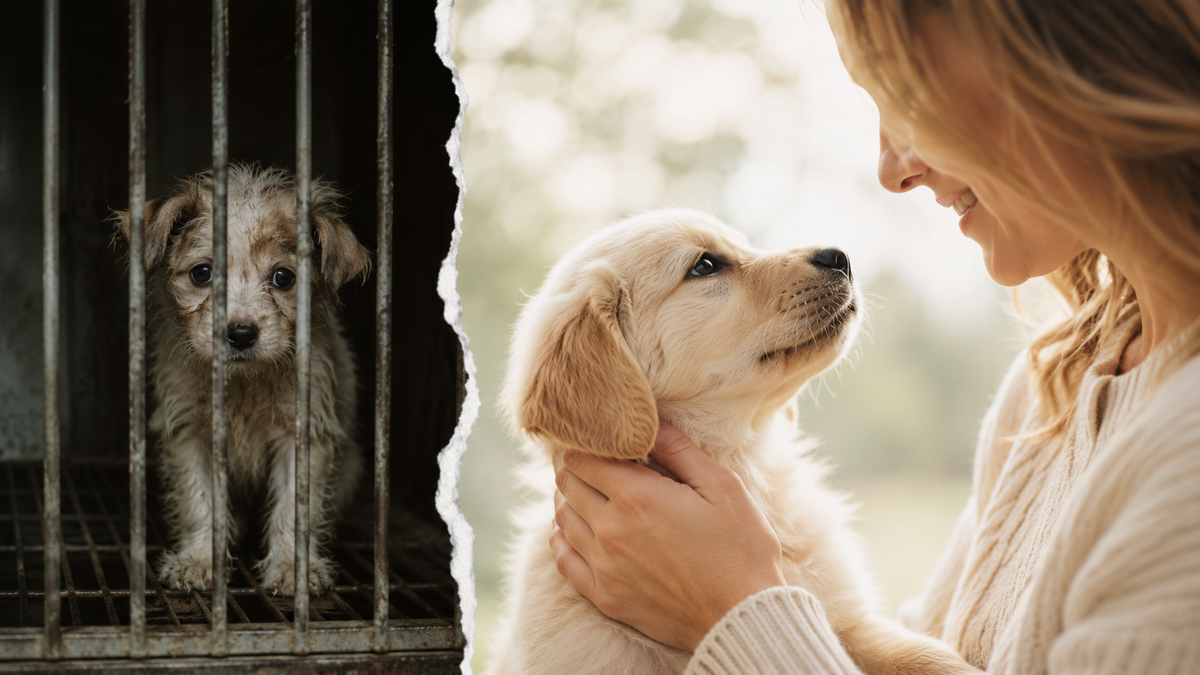
Puppy mills are often perceived by the public as an “extreme case”: dark halls, hundreds of female dogs, Eastern European vans. That exists—and it is a problem that the German Animal Welfare Association has documented for years as illegal puppy trafficking. But the same structural logic also exists on a smaller scale, right on our doorstep: in the “nice family with a few litters a year,” in the backyard, in the garage, in the living room with no visual contact with the mother. We then call this backyard breeding.
What all these systems have in common is that the dog is produced in an environment that subordinates its developmental needs to sales conditions. The female dog is bred too often, the puppies grow up with too little stimulation, in isolation, or conversely under chronic overstimulation, health examinations are missing or falsified, and the puppies are handed over early—often well before the eighth week of life, right in the middle of the sensitive phase.
The typical warning signs we see again and again
Online ads without clear information about origin, handovers in parking lots or motorway service areas, cash payment, “several puppies available immediately,” no contact with the mother dog, changing locations, several breeds offered at the same time, EU pet passports that do not match the story, and high sales pressure (“tomorrow the last one will be gone”) are not isolated cases. They are the operating system of these structures. If you notice one of these patterns, you should not look for exceptions—you should walk away.
What science knows about early rearing
Research into early puppy development is remarkably consistent. As early as the classic work by Scott and Fuller in the 1960s, sensitive periods were described in which puppies learn to classify environmental stimuli, other dogs, and people as “normal.” If this phase—roughly between the third and the twelfth to fourteenth week of life—is spent in an environment with too little stimulation, stress, or isolation, those gaps can later be closed only to a very limited extent.
In 2013, Kathryn Lord showed that this sensitive phase has shifted in dogs compared with wolves—an indication of how deeply domestication has influenced early development and how time-critical this window is. What puppies do not encounter during these weeks is not simply “caught up on” later. It becomes an unknown, potentially threatening stimulus.
Stress, bond, and the mother dog’s nervous system
The prenatal and early postnatal phases have an even more fundamental effect. Chronically stressed mother dogs pass on an altered internal environment to their puppies through cortisol and other stress mediators. Studies on maternal deprivation and early stress exposure—both in dogs and in comparable mammalian models—show lifelong effects on stress regulation, impulse control, and social behavior. A puppy that grows up in a puppy mill with an overwhelmed, fearful female dog starts life with a nervous system that is already calibrated to “danger.”
In practice, we see this every day: dogs that are not “badly trained,” but are structurally harder to regulate. Dogs that cannot cope with normal everyday stimulation because they never learned that the world can be predictable at all. From a training perspective, this can be worked with—but it is a different starting point. And that starting point was set long before the first training session.
Why restricted breed dogs are particularly affected
There is one area that concerns us especially in our work: the breeding of American Staffordshire Terriers, American Pit Bull Terriers, and so-called “XL Bullies.” These breeds have become status symbols in parts of the scene—muscular, “dangerous-looking,” suitable for Instagram. That is exactly what makes them ideal merchandise for backyard structures.
What we see here is a fatal combination: high demand from an environment that rarely asks about temperament stability or health, but about looks. Breeders who mate dogs without any breeding regulations, often closely related animals, often with unknown histories, often with conspicuous parents. And puppies that are handed over early because fast turnover is the business model. The result is dogs that show exactly the traits that already feed the stigma around restricted breed dogs—and that further harm the breed as a whole.
Our position as a behavior therapist and canine scientist
We live with two of these dogs. Vito, our AmStaff, has been with us from the beginning. Amalia, our APBT female, came to us at six months—so already after the sensitive phase. We know from our own experience how great the difference is between good and poor early rearing, and we know from our work how many of these dogs come from structures that never prepared them for a normal life.
That is why our position is clear: anyone who wants a restricted breed dog carries a particularly high level of responsibility when choosing the source. Not because these dogs are “dangerous”—as a breed, they are not. But because the structures in which they are now predominantly bred systematically harm them and their dog owners. Every puppy bought from a backyard breeder continues to finance this system.
How we recognize responsible breeding and responsible animal welfare
The good news: if you look closely, you can recognize the differences. Responsible breeders show their dogs in the environment where the puppies grow up. The mother dog is visible, approachable, and her temperament can be assessed. The puppies are handed over no earlier than eight weeks, often not until nine or ten weeks. There is a relationship with a veterinarian, documented health examinations of the parent animals, a traceable pedigree, and usually a clear selection conversation in which not only do we assess the breeder, but the breeder also assesses us.
The same applies to responsible animal welfare: a transparent history, an honest assessment of the dog, pre- and post-adoption checks, a clear return agreement, no pressure. Here, too, the logic is not “place as quickly as possible,” but “place as appropriately as possible.”
The questions we would ask before buying any puppy
How many litters has the female dog already had? How old is she? May we see her, make contact with her, and observe her behavior? Where and how are the puppies growing up? What does a typical day in the first eight weeks look like? Which stimuli do they get to know? Which health examinations are available for the parent animals? What happens if, for an important reason, we are no longer able to keep the dog at some point? Anyone who does not answer one of these questions, or answers evasively, gives us the answer we need.
The responsibility of buyers—without black-and-white thinking
There is one narrative we deliberately do not share: “Anyone who wants a dog should only adopt.” This attitude is well meant, but it does not do justice to reality. Not every dog from animal welfare fits every person, and not every situation that arises from the pressure to adopt is ultimately a good situation—neither for the dog nor for the dog owner. In our practice, we see dogs with severe behavioral problems from international rescue just as we see dogs from backyard litters. The problem is never the source as a label, but the fit.
For us, responsibility therefore means honestly assessing which dog fits our life, and then consistently choosing the source that fits that dog. Sometimes that is a responsible breeder, sometimes a responsible animal welfare organization, sometimes a foster home. It is never the parking-lot deal, the quick online purchase, or the breeder who does not want to show their dogs.
What we can do before we buy
We can take our time. We can look at several litters or several dogs without deciding immediately. We can speak with behavior experts before we buy, not only once the problem is already there. With restricted breed dogs, we can also check whether the structures in our federal state and our daily life really suit this dog. And we can—this may be the most uncomfortable part—choose not to buy if the source is not right. Even if the puppy is sitting in a box in front of us. This is exactly where market change begins: with every single decision that no longer finances a problematic system.
Our Vitomalia conclusion
Puppy mills and backyard breeding are not a fringe phenomenon. They are the logical consequence of demand that wants things to be fast, cheap, and uncritical. And they produce exactly the dogs that most often need help in our practice: insecure, difficult to regulate, stressed early, poorly socialized. With restricted breed dogs—our own breeds—this problem is especially visible and especially consequential, because each of these dogs is perceived as representing an entire breed.
At Vitomalia, we stand for a different attitude. We believe that good dog ownership does not begin with training, but with the decision about which origin we support with our money. We believe that education is more important than quick answers, and that the right long-term question is not “Where can I get a puppy quickly?” but “Which dog suits me—and which source suits this dog?” When suitable dog owners find suitable dogs, everyone benefits in the end: the dogs, the dog owners, and also the breeds that today too often stand in the shadow of their own breeding.
Responsibility does not begin on the first day of training. It begins with the question of whom we believe, what we help finance—and how much time we take before we say yes.