Retrieving often looks simple from the outside: throw something, the dog runs off, comes back, done. In practice, that exact simplification is why retrieving so often becomes hectic, imprecise, or full of conflict. Between picking up, coming back, and giving the item up cleanly, there are several behavior building blocks that a dog does not automatically connect. When you understand these building blocks, you also understand why some dogs can chase balls for hours and still never truly learn to retrieve.
For us, retrieving is therefore not a show exercise, but a training chain. The more clearly this chain is built, the calmer and more cooperative the behavior becomes. This is exactly where meaningful training separates itself from simply chasing after something. With Vito and Amalia, our two bull-type dogs, this is especially visible: both have a pronounced prey orientation that, without a clean structure, would tip into pure arousal. With structure, however, it becomes one of the best cooperation exercises we know.
Retrieving is a behavior chain, not a single action
When we break retrieving down, we see four clearly distinguishable building blocks: controlled picking up, calm holding, purposeful bringing back, and a clean release. Each of these building blocks is its own behavior with its own criteria, its own typical mistakes, and its own reward logic. If you try to train this chain in one step by simply throwing a ball and hoping the dog puts the rest together on their own, you are not truly training any of it cleanly.
This is exactly what Raymond Coppinger describes in his work on the functionality of behavior chains in dogs: what looks like a single action is usually a sequence of modules that the dog learns individually and then links together. This is precisely why working retrievers have been trained in partial building blocks for decades, not in complete run-throughs.
Why the order of training matters
A common mistake in everyday training is practicing the most exciting parts first: throwing and chasing after it. But these are exactly the parts that a dog with prey motivation will usually show on their own anyway. What they do not show on their own is calm holding, purposeful returning, and controlled release. If you start training with the throw, you are therefore almost always training the wrong part.
Instead, we build retrieving backwards, starting with the release. The dog first learns to let an object go from their mouth, then to hold it briefly, then to actively pick it up, and finally to carry it. Only at the very end do we add the throw. This order may feel unfamiliar, but it has been standard in retriever training for generations and explains why these dogs work with such remarkable calm.
Prey interest is not retrieving
A dog who runs off as soon as something flies is first showing prey interest. That is one part of retrieving, but far from the whole picture. It only becomes retrieving when the dog not only catches the object, but also keeps it, carries it back, and voluntarily gives it up again. This exact social component is missing in pure prey behavior.
We very often see dogs who start enthusiastically but prefer to carry the object away, work on it themselves in peace, or turn it into their own game. This is not defiance and not disobedience. It is a different learning stage. The dog has activated the beginning of the prey sequence, but does not yet know the social feedback loop.
What dogs with strong prey orientation especially need
In dogs with a pronounced prey response, including many bull-type dogs like our two, but also many hunting dogs, herding dogs, and mixed breeds with a corresponding predisposition, the first phase of the sequence is activated particularly quickly. As soon as something flies or rolls, the system switches on. This is not a weakness, but a strength that requires structured work.
Vito shows very classically what happens when a dog perceives prey very strongly: he fixates quickly, has a clear grip, and without training would prefer not to give the object up at all. That is exactly why clean retrieving is so valuable for him. It gives his prey system a clearly structured framework in which picking up and giving up carry equal weight. Amalia is more impulsive at the start by comparison, but just as precise in her grip. She also needs clear criteria; otherwise, training tips into chasing.
The typical training mistakes
Most problems in retrieving are not caused by a lack of motivation, but by increasing difficulty too quickly and by unclear criteria. We see four patterns particularly often.
First: increasing distance too early. As soon as a dog has come back once, it is celebrated and the next throw goes farther. But the dog does not yet have a stable return chain. At a greater distance, the framework is missing, they find their own activity or lose focus on the object.
Second: building speed too early. Hectic throws in quick succession create arousal, but not learning. The dog enters a motor loop in which they produce movement without storing criteria. It feels like training, but it is pure ramping up.
Third: throwing without a foundation. If you begin with the throw before holding and giving up are clean, you teach the dog that the most exciting part is chasing after it. The social return chain remains weak. This is exactly how dogs develop who love balls, but have not mastered retrieving.
Fourth: release through pressure. If giving up the item happens through holding on, scolding, or taking it away, the dog learns that return means loss. They hold tighter, avoid you, or begin to chew. A clean release must be rewarded as part of the chain, not treated as the end of the fun.
A clean structure, step by step
We build retrieving in four phases, each of which needs to be stable before the next one is added. This order is based on classic retriever work and on concepts from cooperative care, meaning the principle that the dog actively participates in every training step instead of merely avoiding pressure.
Phase one: release
We begin by teaching the dog to voluntarily give something up. For this, a neutral object in the mouth, a clear cue, and a reward as soon as the object is released are enough. What matters is that giving it up is not a loss. Immediately after the release, either the object comes back or another strong reward follows. The dog learns: return is worthwhile.
Phase two: holding
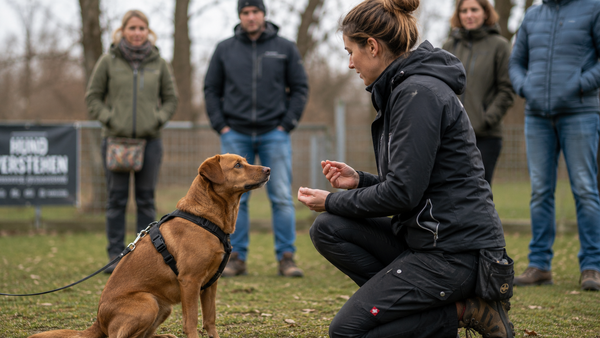
Only once the release is clean do we practice calm holding. The dog picks up an object and keeps it in their mouth briefly, without chewing, turning it, or dropping it. Here, seconds count, not minutes. We increase in very small steps. First a stable two seconds, then three, then five, and all of that in different positions.
Phase three: picking up
Next, we train active picking up from the ground. At first, the object lies directly in front of the dog, later at a short distance, later behind distractions. Here, too, it is not about speed, but about clarity. The dog should deliberately pick up the object and orient back, not grab it and run away.
Phase four: carrying and the return chain
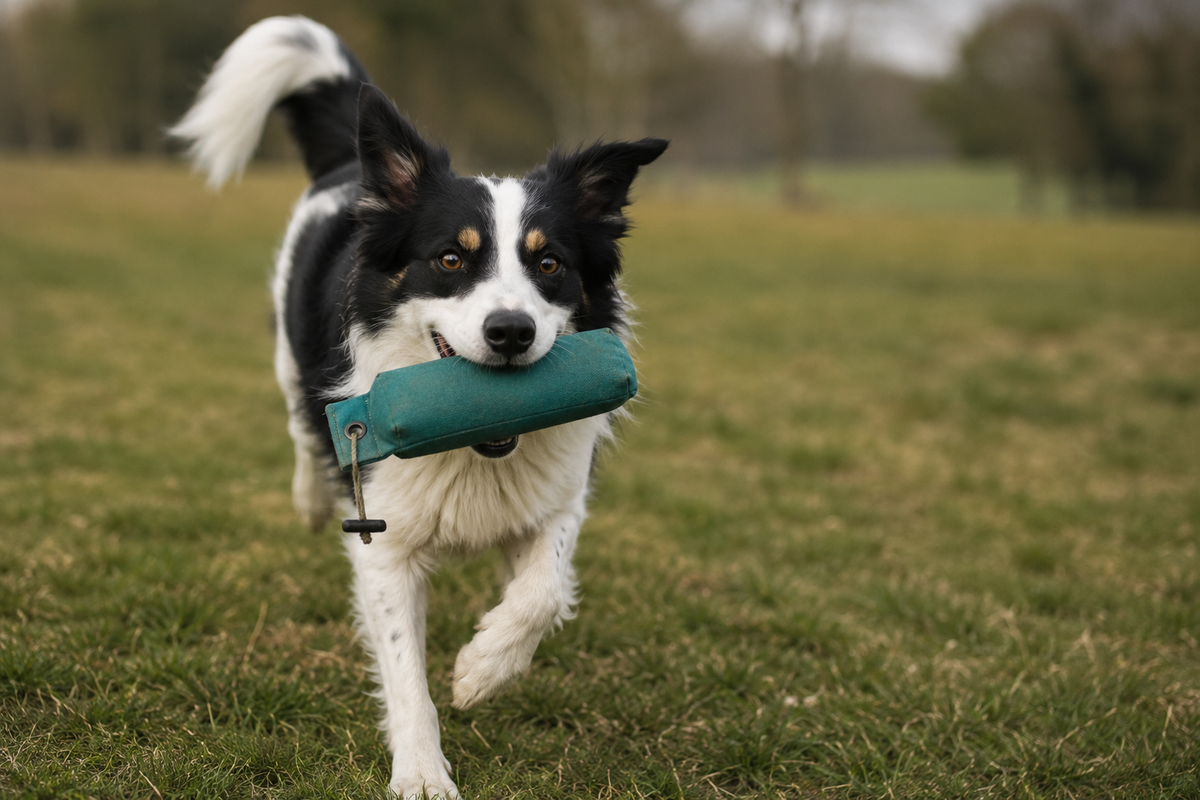
Only at the end do we add carrying, meaning the actual return chain. The dog picks the object up, turns around, comes back, and gives it up. Only when this is stable nearby do we increase distance. Only when distance is stable do we add movement. Only when movement is stable do we actually throw.
Retrieving as relationship training
When retrieving is built this way, it becomes more than an activity. It becomes one of the most concentrated communication exercises we have with a dog. Every sequence contains a negotiation: when does the dog give the item up, how do they pick it up, how do they read the human, how does the human read them. This is cooperation in a very compact space.
That is exactly why retrieving is poorly suited as pure energy release. If you throw a ball a hundred times in a row, you are not training cooperation; you are creating escalation. The dog becomes more tired, but not calmer. Studies on arousal regulation show that such high-frequency stimulus patterns can keep the sympathetic nervous system elevated long-term and therefore create the opposite of enrichment and exercise: constant activation.
With Vito and Amalia, we notice this difference very clearly. A short, clearly structured retrieving session with few repetitions, clear criteria, and real breaks meets their needs noticeably better than a long ball-throwing session. Both settle afterward, sleep deeply, and are more relaxed in everyday life. With pure chasing, the opposite would be the case.
What we pay particular attention to with listed breeds
In dogs with a strong prey response, and that includes our two bull-type dogs just as much as many other breeds with high drive, structured retrieving is an especially valuable tool. It offers their prey system a clear framework in which picking up and giving up are equally important. It trains impulse control in exactly the context where it otherwise tends to break down, namely in the prey impulse. And it gives these dogs a task that fits their nature without keeping their arousal permanently high.
At the same time, with these dogs in particular, the temptation is strong to make the training fast and focus on spectacle. That is exactly the point where we most strongly recommend working more slowly. A clean behavior chain is worth more for a bull-type dog or any other high-drive dog than any show sequence. It changes not only retrieving, but everyday life.
Our Vitomalia conclusion
Retrieving is not a single action. It is a behavior chain made up of controlled picking up, calm holding, purposeful bringing back, and clean giving up. If you train all four building blocks, you get a dog who works with calm. If you only train chasing after something, you get a dog who runs well and comes back poorly.
For us, retrieving is therefore not an activity trick, and certainly not a way to burn off energy. It is cooperation training, impulse control, and relationship work in one single exercise. Especially in dogs with high prey motivation, like our two, the value of this structure shows every day. When trained cleanly, a wild sequence becomes a shared language, and that is exactly the difference between hectic throwing and true retrieving.
Sources
Coppinger, R. & Coppinger, L. (2001). Dogs: A Startling New Understanding of Canine Origin, Behavior & Evolution. Scribner. — Miklósi, Á. (2015). Dog Behaviour, Evolution, and Cognition. Oxford University Press. — Jouventin, P. & Aubin, T. — Research on prey instinct and sequence behavior in canids. — McConnell, P. — Work on arousal regulation and sympathetic activation in dogs. — Snider, K. — Cooperative care and positive development of retrieve behavior. — Working dog training literature: classic retriever training and backward chaining in retrieve sequences.