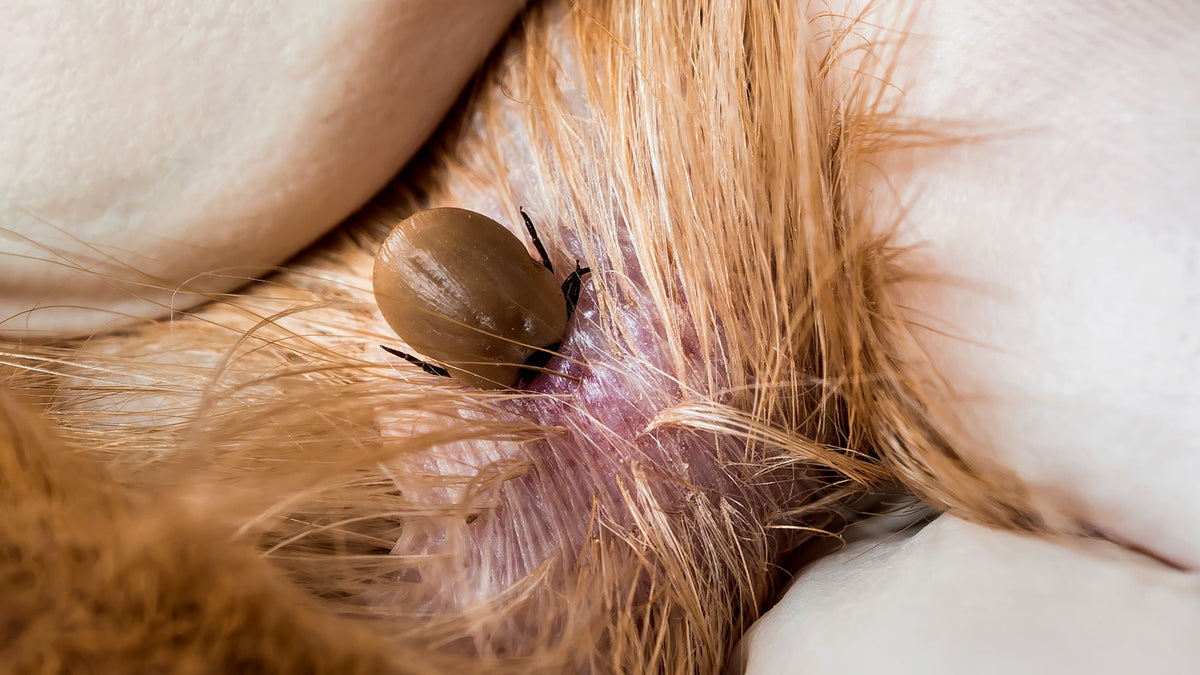
Zeckenschutz ist keine Geschmacksfrage, sondern eine Risikoabwägung. Wir erklären, warum Region, Saison, Alltag und Verträglichkeit darüber entscheiden, welche Strategie für einen Hund sinnvoll ist.
Tick protection is not a question of fashion, nor is it purely a marketing debate. It is about real, sometimes life-threatening diseases: Lyme borreliosis, babesiosis, anaplasmosis, ehrlichiosis, TBE and, in certain regions, increasingly hepatozoonosis. Keeping this in mind helps you assess prevention more objectively and make better everyday decisions.
We are regularly asked about this topic because there are so many half-truths. Some swear by a tablet for six months, while others reject every form of “chemistry” and rely exclusively on coconut oil. Both camps argue with conviction, but rarely with data. This is exactly where we want to start: we classify the strategies, look at what the current body of research says, and explain why the answer is almost always regional, seasonal and specific to the individual dog. This guide is the overview of the entire tick series. In the four detailed articles, we then go deeper into active ingredients, natural alternatives, safe removal and systematic checking.
Why tick protection deserves more attention today than it used to
Twenty years ago, when people talked about ticks, they usually thought of Lyme borreliosis and a few weeks in early summer. That time is over. In its Guideline 1 on tick control in dogs and cats, the European Scientific Counsel Companion Animal Parasites (ESCCAP) explicitly documents that both tick activity periods and their geographical distribution have changed significantly in recent years. Mild winters, longer transitional seasons and changes in land use mean that ticks can be active all year round in many regions as soon as temperatures stay above around 7 degrees for several days.
In addition, climate change is bringing in species that were still a marginal phenomenon here just a few decades ago. The ornate dog tick (Dermacentor reticulatus) has spread from individual hotspots in southern Germany across large parts of Central Europe and is the main vector of babesiosis, a potentially fatal disease in dogs. The tropical Hyalomma tick has been detected regularly in Germany for several years and is considered a vector of Crimean-Congo fever as well as various rickettsioses. The Companion Vector-Borne Diseases (CVBD) World Forum updates its distribution maps annually, clearly showing how dynamically the situation is developing.
For us as dog owners, this does not mean we need to panic. But it does mean that risk assessment should be individual and up to date. Anyone planning based on the state of knowledge from ten years ago will miss relevant developments.
Which diseases ticks actually transmit
For prevention to make sense at all, it is worth briefly understanding the most important pathogens. Lyme borreliosis is transmitted by Borrelia burgdorferi, primarily through the castor bean tick (Ixodes ricinus). In dogs, infection is often subclinical, but it can lead to joint problems, lethargy and, in rare cases, kidney disease. Anaplasmosis (Anaplasma phagocytophilum) is also transmitted by the castor bean tick and, in symptomatic dogs, usually presents with fever, fatigue and thrombocytopenia.
Babesiosis is probably the best-known “canine disease” transmitted by the ornate dog tick and, if left untreated, can be fatal within a few days. Ehrlichiosis, hepatozoonosis and, in limited regions, tick-borne encephalitis (TBE) complete the picture. The WSAVA Vector-Borne Disease Guidelines summarize the current status of diagnosis and treatment for these diseases and emphasize that, in almost all cases, prevention is far more effective and gentler than any treatment after a manifest infection.
What the actual risk depends on
There can be no blanket answer to how much tick protection is “right”, because the relevant variables differ greatly from dog to dog. We see four dimensions that every dog owner should honestly work through.
Region. Anyone living in Bavaria, Baden-Württemberg, Saxony, Thuringia or parts of Hesse is, according to the RKI definition, in a TBE risk area. Here, the balance shifts clearly towards reliable protection. In regions with a high density of ornate dog ticks, such as Brandenburg, Saxony-Anhalt or the Upper Rhine, babesiosis prevention is the priority. The CVBD maps provide very good initial orientation here.
Season. The classic activity phases are spring and autumn, but mild winters have weakened this logic. The ornate dog tick is particularly active in autumn, winter and early spring — exactly when many dog owners relax protection. This seasonal shift is often underestimated in everyday life.
Lifestyle. A dog that runs through tall grass, forests and meadows every day has a different exposure profile than an urban dog with standard walks on paved paths. Encounters with wildlife, rummaging through undergrowth or travelling to southern Europe also significantly change the risk profile.
Dog. Coat structure, skin sensitivity, age, pre-existing conditions and individual tolerance all play a role. With our two, Vito (American Staffordshire Terrier) and Amalia (American Pit Bull Terrier), we are dealing with short coats, which makes checking easier but at the same time provides little mechanical protection against ticks attaching. In long-haired breeds, this assessment shifts again.
The four strategy categories at a glance
Anyone who looks systematically at tick protection will encounter four main categories. We deliberately outline only their basic logic here. Active ingredients, the state of research and specific selection criteria are covered in the respective detailed articles in this series.
Chemical spot-ons and tablets
This group includes the preparations most commonly used today. Among orally administered tablets, the isoxazoline class of active ingredients dominates (fluralaner, afoxolaner, sarolaner, lotilaner). They act systemically and kill ticks once they start feeding on the dog. Spot-ons often contain active ingredients such as permethrin, fipronil or imidacloprid and act via the skin surface and the sebaceous gland system. ESCCAP rates these classes of active ingredients as highly effective, while also pointing out the spectrum of possible side effects. We go into what to look for specifically in terms of selection and tolerance in the article comparing chemical tick protection.
Collars with long-acting active ingredients
Anti-tick Collars often combine imidacloprid and flumethrin and exert their effect over several months. They have advantages for dog owners who prefer not to use monthly spot-ons or tablets, and studies show a comparatively consistent protective effect. At the same time, the following applies: they are not suitable for every dog and every situation, for example where there is close contact with small children or known skin sensitivities.
Natural remedies and gentler approaches
Coconut oil, black cumin seed oil, amber necklaces, essential oils, EM ceramics: the list is long and the marketing is often euphoric. The scientific evidence here is much thinner than for chemical preparations, although individual studies show at least a partial repellent effect for certain substances. We do not consider natural approaches to be an equivalent alternative to effective acaricides in high-risk regions, but we do see areas of application, especially in situations with lower exposure or as a supplement. We look in detail at which remedies have which evidence in the article on natural tick protection.
Mechanical prevention: checking and removing
This strategy is often underestimated, but according to ESCCAP it is a fixed component of any serious prevention approach. Studies on pathogen transmission show relatively consistently that the earlier a tick is removed, the lower the likelihood of pathogen transmission. For borrelia, the transmission risk is still very low in the first hours after attachment and then increases. Babesia, by contrast, can be transmitted much faster, which is why chemical protection plays a greater role here. We have covered how to check systematically and remove ticks safely in detail in two dedicated articles in this series.
How we make concrete decisions
We are often asked what we “give our dogs”. The honest answer is: it depends on the year, the region, the planned activity and the current state of health. We vary this deliberately because conditions change and because we do not want to defend a single strategy dogmatically.
What has proven useful for us is a clear decision pathway. First, assess the risk realistically — in other words, honestly look at the region, season and planned activities. Then consider the dog individually: tolerance, skin condition, pre-existing illnesses. Next, choose the appropriate main strategy, whether chemical, Collar, natural or a combination. And finally, regardless of that choice, never leave out the mechanical component, because it complements every other strategy and does no harm in any scenario.
At its core, this approach follows the logic of the ESCCAP recommendations: individual risk analysis instead of blanket recommendations. That is exactly why we find it problematic when people speak in general terms about a “best tablet” or an “only correct remedy”. Such statements ignore the variability that is decisive in practice.
What dog owner responsibility remains, regardless of strategy
Regardless of the chosen protection, the following applies: check after every walk, especially during risk periods. Take noticeable skin changes, lethargy, fever, unusual lameness or changes in behavior seriously and have them assessed by a veterinarian if necessary. Plan travel to regions with a different tick and pathogen spectrum early, because some active ingredients need lead time to build up full protection.
These routines may sound basic, but in practice they make a bigger difference than the detailed choice between two tablet preparations. A perfect tablet is of little use if dog owner responsibility is lost in everyday life.
Our Vitomalia conclusion
Tick protection is not a trend topic, nor is it a matter of belief. It is a sober risk assessment that must be regional, seasonal and individual. Anyone looking for blanket universal solutions almost always overlooks factors that later cause problems.
For us, this means: it is better to calmly go through your own risk profile once, compare the strategies with their real evidence and then make a decision that remains genuinely practical in everyday life. Vito and Amalia do well with the fact that we do not keep their protection rigid, but adapt it to the respective situation. This is not a dogmatic approach; it is simply the one that fits the current data.
In the other articles in the tick series, we go into concrete depth: the active ingredient classes of chemical preparations, the honest classification of natural remedies, the technically clean removal of a tick and systematic checking after a walk. If you understand this guide as a map and the detailed articles as tools, you have the essential basis for an informed decision.