Trödeln wirkt auf Menschen oft wie Nichtstun. Wir erklären, warum langsames Schnüffeln und Erkunden für viele Hunde eine der sinnvollsten Formen von Beschäftigung sein kann.
Dawdling sounds like doing nothing. In reality, it is one of the most demanding cognitive tasks a dog can perform on a walk. While we count distance, pace, and action, the dog beside us is processing a complex scent picture – an amount of information the human brain simply cannot represent.
This is exactly where our observation from daily work begins: Many dogs described as “not getting enough enrichment and exercise” or “always in the red zone” do not need more action. They need more space, more nose work, and more of their own pace. What looks like laziness is often the most effective form of activity there is.
Why sniffing is not laziness, but high-level cognitive work
A dog has around 220 million olfactory receptors; humans have about 5 million. In addition, dogs have a significantly larger olfactory bulb and the vomeronasal organ, which processes additional scent information. Sniffing is therefore not a side activity, but the main modality through which dogs perceive their environment.
Imaging studies in awake dogs (Berns and colleagues, Emory University) show that large areas of the brain are active when processing scents – not only olfactory centers, but also regions linked to emotion, memory, and evaluation. A dog that sniffs is thinking, feeling, and sorting at the same time. That costs energy.
Why ten minutes of nose work often achieves more than an hour of exercise
In practice, we see it again and again: A dog that has sniffed intensively for twenty minutes comes home noticeably calmer than after a fast but low-stimulus round. This aligns with what behavioral research describes – cognitive enrichment and exercise tires a dog differently than purely physical movement, and it reaches deeper into self-regulation.
For us, this is an important point: enrichment and exercise is not all the same. If you only tire your dog physically, you often end up with a tired but internally overstimulated dog. If you allow your dog to sniff, you often get a dog that has truly settled down.
What research says about nose work and well-being
One of the frequently cited studies on this topic comes from Duranton and Horowitz (2019, “Let me sniff! Nosework induces positive judgment bias in pet dogs”, Applied Animal Behaviour Science). The study compared dogs that were regularly allowed to do nose work with a comparison group. The result: The sniffing group showed a stronger positive judgment bias in a standardized test – an indicator associated in animal behavior research with a better emotional state.
In practical terms, this means: Dogs that are regularly allowed to sniff tend to assess ambiguous situations more optimistically. This is not proof of “happiness,” but it is a robust indication that free sniffing has a positive effect on well-being.
Further work from the field of Alexandra Horowitz (Dog Cognition Lab, Barnard College) and R. T. S. McGowan on olfactory enrichment points in the same direction: Scent opportunities – whether on walks or in everyday life – are one of the most resource-efficient and effective forms of enrichment. They cost the dog owner little and give the dog a great deal.
Down-regulating arousal instead of driving it up
A second aspect that is often underestimated in practice: Sniffing seems to be associated with a shift toward the parasympathetic nervous system. Deep, steady nose work – head down, calm breathing rate – is physiologically a different state than panting pursuit behind a ball. When sniffing, the dog does not ramp up, but often visibly settles down.
This is exactly why we recommend dawdling walks especially where dogs are already moving through life with a high arousal level: for reactive dogs, for dogs with limited impulse control, for many listed dogs who are under constant scrutiny in everyday life, and for sensitive animals who find it difficult to settle.
The “Decompression Walk” – a concept that fits us well
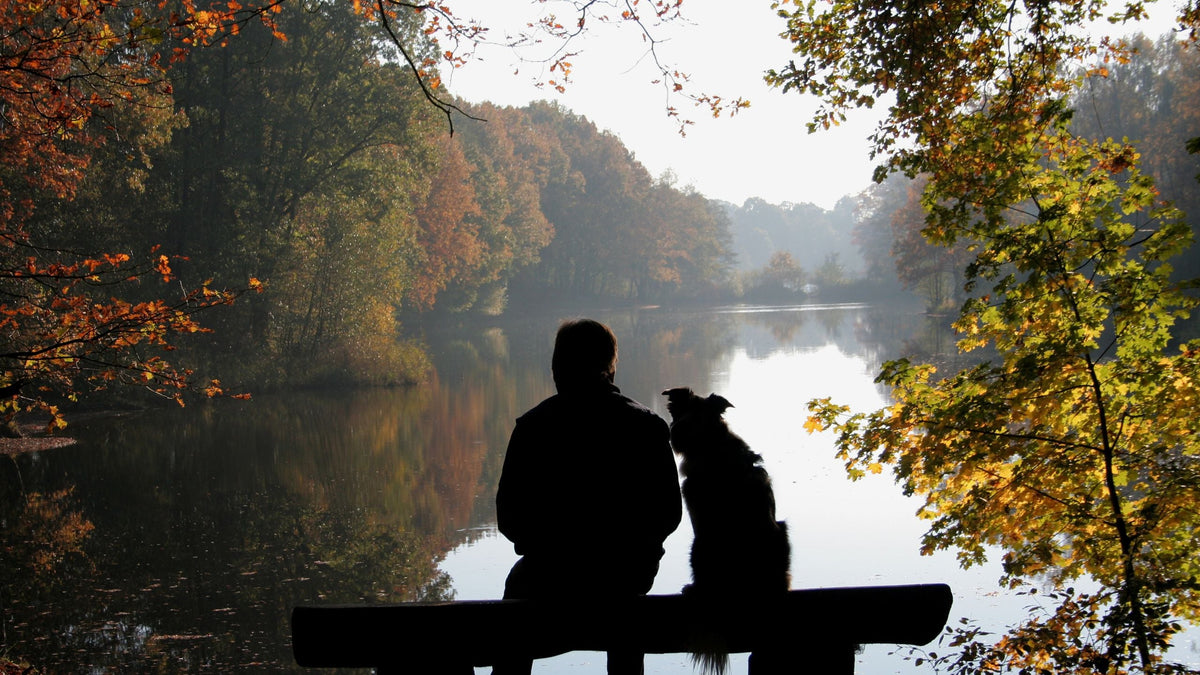
In the English-speaking world, the term “Decompression Walk” has become established for this kind of walk, shaped in part by trainers such as Sarah Stremming and Trish McMillan. The idea is simple: In quiet places, ideally away from the stimulus potential of the city, on a long Leash or Long Leash, the dog determines the pace, direction, and breaks. The human accompanies, speaks little, does not constantly correct, and does not demand.
It sounds unspectacular – and that is exactly the point. For many dogs, “not having to do anything” is the rarest experience in their everyday life. They have to function, adapt to expectations, and cope in a dense environment. A Decompression Walk gives them a framework in which they are allowed to be dogs again.
What a dawdling walk looks like in practice
We see implementation less as a method with a fixed structure, and more as an attitude. Even so, a few simple guidelines help:
- Choose a quiet environment where neither encounters nor traffic are constantly disruptive.
- Use a long Leash or Long Leash attached to a well-fitting Harness so the dog has room to move.
- Speak little, give few cues, guide only minimally. The dog leads; the human accompanies.
- Allow breaks where a dog stands in one place for several minutes. What seems boring to us is often highly informative for them.
- Do not define the walk by distance or time, but by quality: Does the dog seem softer, more regulated, more settled at the end?
With Vito and Amalia, we notice this very clearly. Thirty to forty minutes of genuine dawdling – nose in the grass, their own pace, hardly any verbal input – does both of them demonstrably more good than two hours of action in which we, as humans, try to prove how well we can provide “enrichment and exercise.”
Why dawdling can change so much, especially for reactive dogs and listed dogs
Dogs that ramp up quickly – whether due to genetics, learning history, or simply a demanding environment – need one thing above all: opportunities for their system to down-regulate again. Movement alone does not reliably achieve this. Action with a high arousal component often even reinforces the problem: The dog becomes physically more tired, but emotionally more charged.
Dawdling walks act as a counterbalance here. They reduce external demands, allow self-efficacy (“I decide what I look at”), and give the nervous system time to sort itself out. This is not a miracle solution and it does not replace behavioral therapy for severe reactivity – but it is one of the most consistent foundational measures we know.
What dawdling is not
An honest classification matters to us here: Dawdling is not a replacement for structured training, not a cure-all, and not an excuse for a low-stimulus everyday life. Dogs still need clear learning content, appropriately dosed physical exercise, social experiences, and orientation in everyday life. Dawdling is one building block – but one that makes the biggest difference for many dogs because it strengthens self-regulation rather than overriding it.
Our Vitomalia conclusion
We do not see dawdling as a break from the “real” walk, but as one of its most demanding forms. When you allow a dog to sniff and make choices, you give them space for what they are evolutionarily best at – and at the same time you relieve their nervous system.
For us, this fits an attitude we stand for in many areas: less constant entertainment, more quality. Less pressure for humans to prove something, more trust in the dog. If we think honestly about activity, we should not ask how much a dog does, but how well they rest within themselves afterward. Dawdling is one of the most honest answers we know.