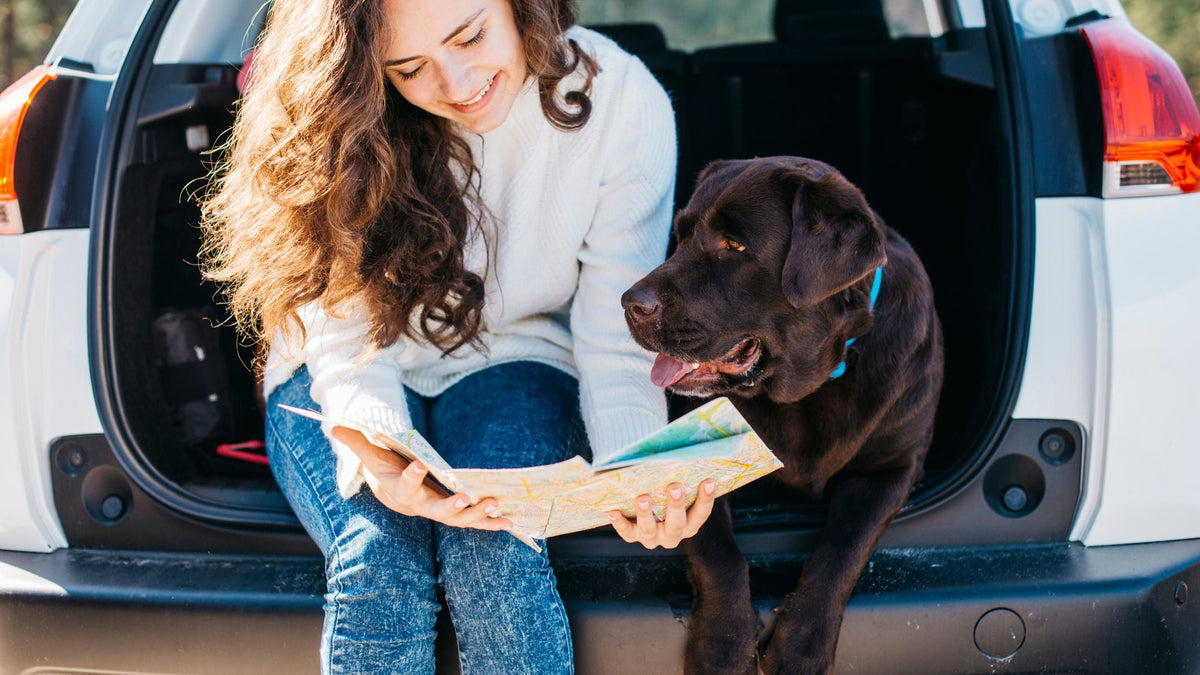
Lange Autofahrten mit Hund stehen und fallen mit Vorbereitung. Wir erklären, warum Gewöhnung, Sicherung und realistische Pausenplanung wichtiger sind als jedes Last-Minute-Gadget.
A long car journey with your dog is not something to improvise along the way. It is decided beforehand: in how your dog is secured, in the training, and in the question of how well your dog copes with the car in the first place. We have spent years getting Vito and Amalia used to routes of every length, and that is exactly why we know: most problems on long journeys do not start with the distance, but with the preparation.
Long car journeys involve three levels at the same time. Safety in the legal and physical sense. Health, especially motion sickness and heat management. And stress regulation, meaning how calmly your dog can truly cope with the hours in the car. If you ignore one of these levels, you risk the others becoming unstable too.
A dog in the car is cargo, not a passenger
Legally, the situation in Germany is clear. Under Section 22 of the German Road Traffic Regulations (StVO), every animal in a vehicle is considered cargo, and cargo must be stowed and secured in such a way that it cannot slip, fall over, or endanger vehicle occupants, even during emergency braking or evasive maneuvers. In addition, Section 23(1) StVO requires that the driver’s view and attention must not be impaired by anything, including a dog moving freely around the vehicle. Anyone who violates this risks not only a fine, but also insurance issues in the event of an accident.
For us, however, this is not a legal detail, but a question of safety. Crash tests by ADAC and DEKRA have shown the same picture for years: an unsecured dog becomes a projectile on impact. At an impact speed of 50 km/h, around 25 to 35 times the dog’s body weight acts on the dog’s body. A 25-kilo dog can therefore develop an impact force in the range of about 600 to 900 kilograms. This can not only seriously injure the dog, but also kill the people in the vehicle.
What safe transport solutions must provide
Three solutions are established in practice: a crash-tested transport crate in the trunk, a partition grille combined with a non-slip mat, or a crash-tested safety harness with a short attachment on the back seat. The deciding factor is not the concept, but the testing. Many commercially available Harnesses and crates simply do not withstand real impact loads. If you want to be on the safe side, use the annually updated comparison tests by ADAC, Stiftung Warentest, or the TCS as guidance.
For Vito and Amalia, we use solid transport crates strapped securely into the vehicle. For us, this has the advantage that both dogs have a clearly defined retreat space that does not change, no matter where we park or what is happening outside. Especially for restricted breed dogs, who in many German federal states must wear a muzzle and Leash outside the vehicle, the crate is an important calm space where they can relax without a muzzle.
Motion sickness is a medical issue, not a training problem
When dogs drool in the car, pant, curl up, or vomit, it is rarely drama or bad behavior. It is motion sickness, and it has a clear physiological basis. The vestibular system in the inner ear reports movement, while the eyes and body provide contradictory information. The brain interprets this conflict as possible poisoning and triggers nausea.
Veterinary studies consistently show that puppies and young dogs are affected significantly more often than adult dogs. The reason lies in the inner ear not yet being fully developed. Many dogs grow out of motion sickness, but not all. For some, it persists, often intensified by learned fear because the dog has associated the car with nausea.
What helps and what does not
In our consultations, we always separate two levels: behavior training and the medical component. On the behavioral side, slow counterconditioning helps. Short journeys that end positively, without vomiting and without escalating stress, are often more effective than any treat trick on the seat. It is important that the dog is not overfed before the journey. A small meal two to three hours beforehand is usually better than an empty stomach or a full portion immediately before getting in.
On the medical side, there is one active ingredient with good evidence: maropitant, approved in the EU as Cerenia. If the dog is primarily panicked rather than nauseous, a different strategy is needed, often in consultation with a veterinarian with additional qualifications in behavioral medicine. Giving medication as a blanket measure without veterinary advice is not sensible.
Breaks, water, reading stress: what really matters on the road
Long journeys need rhythm. We plan breaks every two to three hours, not as spontaneous toilet stops, but as planned units. Offer water, take a short movement break, no wild play, no meetings with unfamiliar dogs at the rest area. That is not recovery; it is just the next flood of stimuli. Especially in hot weather, it is crucial to take breaks in the shade and generally avoid leaving the car in direct sun. Interior temperatures in parked vehicles rise to life-threatening levels within just a few minutes, even when outside temperatures are only moderately warm.
You can read stress in a dog if you know what to look for. Increased panting without heat, drooling, trembling, constant repositioning, wide-open eyes with visible whites, closed mouth corners, or lying rigidly are not questions of character, but physiological signals. If you ignore them, you risk acute stress turning into chronic avoidance behavior.
Before the journey: enrichment and exercise yes, overstimulation no
A dog whose needs for enrichment and exercise have been met will travel more calmly. But enrichment and exercise does not mean two hours of dog encounters at the dog training field immediately before departure. Highly aroused dogs need hours, sometimes a whole day, to come back down. Before long journeys, we rely on calm, sniffing walks without major social stimuli. This reliably tires a dog out without winding them up.
Restricted breed dogs on the road: additional planning instead of travel anxiety
With restricted breed dogs, you cannot simply drive through Germany from a legal point of view. Muzzle and leash requirement regulations vary from one federal state to another, and some states even require temperament tests or permits that do not automatically apply beyond your home state. Anyone planning a longer route with a restricted breed dog should check the rules of all federal states that will be crossed before departure and, if in doubt, have the relevant wording of the dog laws to hand.
In practical terms, this means: a suitable, well-fitting muzzle for breaks, sufficient access to water even while wearing the muzzle, a Leash that is also permitted in federal states with a short maximum length, and documents such as a temperament test or proof of expertise within easy reach, not in a suitcase in the trunk. On our own journeys with Vito and Amalia, we have learned that calm, planned preparation makes the decisive difference. If you only start looking for the muzzle at the rest area, you make your dog nervous — and yourself too.
Our Vitomalia conclusion
A long car journey with your dog is safety work, health work, and relationship work all at once. Securing your dog is not negotiable, because physics is not negotiable. Motion sickness is a medical issue, not a training mistake, and should be taken seriously. Stress regulation does not arise in the moment; it is trained weeks in advance. And with restricted breed dogs, there is an additional layer of legal planning that cannot be improvised.
For us, a good long car journey is one that feels almost uneventful when you arrive. No drama, no vomiting, no overstimulated dogs, no improvised solutions at the roadside. If your dog gets out at the destination, shakes off, and simply carries on, you have done everything right. That is exactly the goal.