Sollten wir nur noch aus dem Tierschutz adoptieren? Wir erklären, warum die Debatte berechtigt ist, aber moralische Eindeutigkeit an der Realität von Zucht, Tierheimen und Halterverantwortung vorbeigeht.
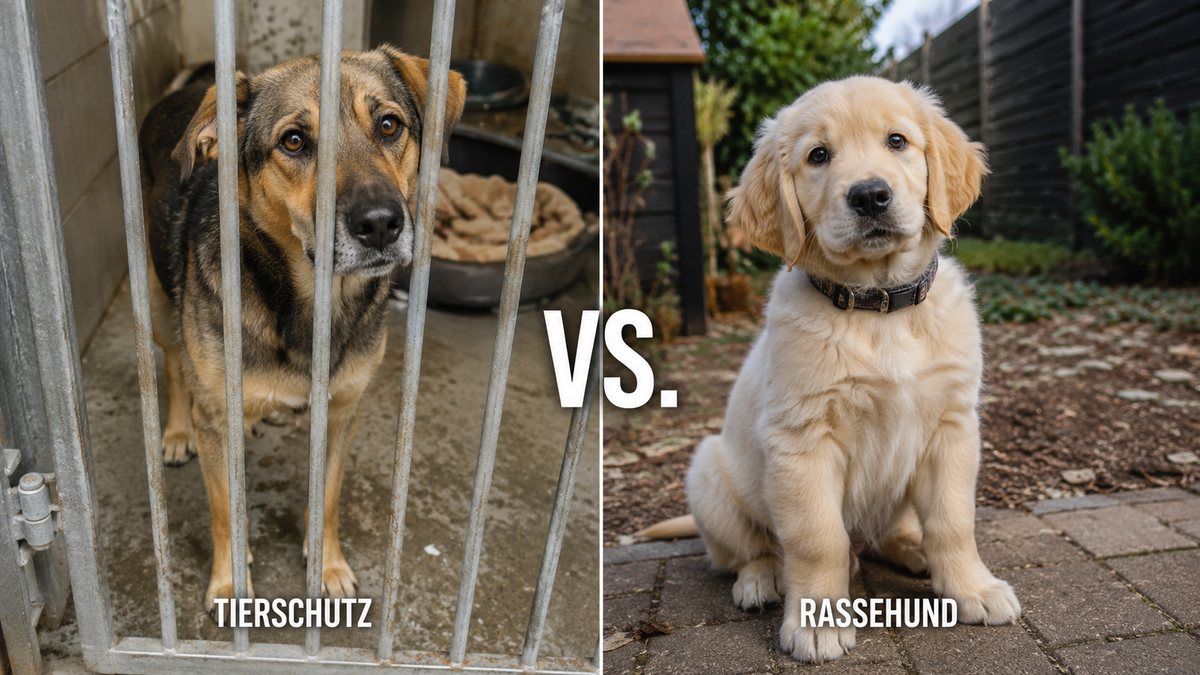
Shelter dogs vs. pedigree dogs — the debate that is often conducted with more heat than most election campaigns. On one side, the clear demand: “Adopt, don’t shop.” On the other, the equally clear conviction: “A good dog only comes from a reputable breeder.” We have been observing this discussion for years — in our daily work with dog owners, in comment sections, at dog training grounds. And we believe: both camps have a point. And both camps have blind spots.
As a dog behavior therapist and canine scientist, we see the outcomes of both paths — dogs from animal shelters, from international animal welfare, from reputable kennels, from backyard breeding. We know that the honest answer rarely fits into a hashtag. It is more nuanced, more evidence-based, and above all: more individual.
In this article, we want to take a well-founded look at both paths — without ideological bias, with the current state of research, and with guidance that helps you make a decision that is right for you.
Why the debate is so emotional
The debate around shelter dogs vs. pedigree breeding is so charged because it touches on two deeply human needs: the need to save a living being, and the need for planning security for the next ten to fifteen years of your own life. Both are legitimate. Both are understandable. And both lead to very different conclusions.
The adoption imperative and its downside
The message “Adopt, don’t shop” has gained enormous support in recent years — and for good reason. Animal shelters in Germany and other European countries are full. International animal welfare organizations rescue dogs from situations that are, in some cases, very serious. Anyone who gives such a dog a home makes a valuable contribution.
What we often see in our practice, however, is this: people who, out of moral conviction, have chosen a rescue dog whose profile of needs does not fit their everyday life. The well-intentioned adoption imperative can lead to people and dogs coming together under conditions that overwhelm both sides. This is not an argument against adoption — it is an argument for honest self-assessment.
The pedigree dog reflex and its downside
On the other hand, there is the wish for predictability. If you get a pedigree dog from a reputable breeder, you usually know both parent dogs, the rearing conditions, and the key breed-typical traits. That is a real advantage — especially for first-time dog owners, families with young children, or people with specific requirements (e.g., allergies, activity level, working purpose).
The downside: where there is demand, disreputable offers emerge. Puppy mills, backyard breeders, and the cross-border online puppy trade are a huge problem — and from the outside, they are hard to distinguish from responsible breeders. The blanket statement “A pedigree dog from a breeder is the safe choice” is therefore just as incomplete as a blanket imperative to adopt.
Animal shelters and international animal welfare: what we know professionally
A dog placed through animal welfare almost always comes with a history that we know only in fragments. This unknown is not a problem in itself — but it is a professional reality that needs to be named.
The sensitive phase as a key factor
Canine research today knows very clearly how crucial the first weeks of life are. Between the third and twelfth week, in some cases up to the fourteenth week, puppies go through what is known as a sensitive phase. During this time, they learn what belongs to a normal environment: people, sounds, changes in surface, other animals, everyday stimuli. What they do not get to know during this phase is often perceived as threatening later on.
This is exactly where the professional challenge lies with rescue dogs: we often do not know whether, or how, this phase took place. In the case of a street puppy from Southern Europe, an illicitly bred puppy, or a dog that spent its first months in a shelter facility, the likelihood is higher that key socialization experiences are missing.
International animal welfare: emotion and reality
International animal welfare is a topic we approach with respect for the work of many dedicated people — and at the same time with professional clarity. Veterinary professional associations have been pointing out for years that imported dogs often enter the country with Mediterranean diseases (leishmaniasis, ehrlichiosis, babesiosis, dirofilariasis), whose diagnosis and treatment can involve years of responsibility.
There is also the behavioral aspect: dogs born on the street or in animal rescue centers in southern Europe have often never experienced a typical family life. Some thrive in a calm home. Others struggle throughout their lives with the density of stimuli in a German big city. Both outcomes exist — and we have seen both in our consultations.
What makes animal shelter adoption responsible
We are firm advocates of animal shelter adoption — provided it is done with proper information. For us, that means: an honest self-assessment of your own competence as a dog owner, several visits to the shelter, walks together before adoption, transparent information from the organization about known behavioral issues, and ideally professional support during the first few months. Approaching adoption in this way helps avoid the most common frustrations — and gives the dog the fairest chance to settle in well.
Reputable pedigree breeding: how to recognize it
When we talk to dog owners about breeding, we often hear: “How am I, as a layperson, supposed to recognize a reputable breeder?” In fact, there are clear criteria — and taken together, they create a fairly clear picture.
Transparency and health examinations
A reputable breeder shows both parent dogs, documents health examinations (breed-specific, e.g. HD/ED X-rays, eye examinations, heart ultrasound, genetic tests), carries out a temperament assessment of the parent dogs, and has clear answers to critical questions. Anyone who evades a detailed email or reacts irritably is very likely not the right contact.
Rearing conditions
With reputable breeders, puppies are raised within the family setting — not in isolated boxes, not in an outdoor kennel without social contact. They get to know vacuum cleaners, doorbells, climbing stairs, car rides, and encounters with different people. This wealth of experience during the sensitive phase is exactly the major advantage of good breeding.
Number of litters and selection of families
One indicator that is often overlooked: How many litters does the female dog have per year and over her lifetime? How many female dogs live in the household at the same time? Reputable breeders usually have few litters, a limited number of breeding dogs, and a manageable everyday life around the litter. And: they choose puppy families carefully — if you are not asked any questions, you should pay close attention.
Where reputable breeding reaches its limits
We want to stay honest: even within reputable breeding, there are topics that need to be viewed critically from a professional perspective — especially in brachycephalic breeds (short-muzzled dogs such as Pugs, English Bulldogs, and French Bulldogs), where breeding history has led to serious health problems. Veterinary professional associations have published clear position papers on this. A VDH document or a high price also does not automatically protect against traits associated with harmful breeding. Anyone who wants a purebred dog should understand the health risks typical of the breed.
Puppy mills and backyard breeding: the clear boundary
If there is one point where differentiation ends, it is here. Puppy mills, illegal online puppy trading, and backyard breeding are not a “middle way,” not a “more affordable entry point,” and not a “mix of both worlds.” They are a problem for everyone involved — the puppies, the mother dogs, and ultimately the families who take in such a dog.
What we take from this: early rearing shapes a dog’s entire life. Anyone who buys a puppy from an online ad listed as “cheap to rehome,” from a parking lot, or out of a car trunk is not only taking the risk of a dog with behavioral issues — they are financing a system built on suffering. There is no gray area here.
The special case of restricted breed dogs — our professional focus
Restricted breed dogs are especially close to our hearts because we live in this world ourselves with our own dogs Vito (AmStaff) and Amalia (APBT) — and because we support many dog owners who bring home a restricted breed dog from animal welfare or from a breeder.
Restricted breed dog from animal welfare: responsibility with special requirements
Statistically, restricted breed dogs in shelters have longer stays than other breeds — simply because fewer people feel able to take on an adoption legally, socially, and emotionally. Anyone who adopts here makes a real contribution. At the same time, the already higher demands on dog owner competence increase further when the dog has an unclear history. That is not an obstacle — but it is a reality we should not romanticize away.
Restricted breed dog from a breeder: A legitimate choice
At the same time, there is no contradiction in getting a restricted breed dog from a reputable breeder. For someone who wants a stable, well-socialized puppy with known genetics — and who already meets the ownership requirements of their federal state — this path is professionally understandable. Both paths are legitimate. Both need suitable dog owners.
Amalia’s story — a transitional form
Our female dog Amalia came to us at six months old. That is neither the classic way of getting a puppy from a breeder (eight to ten weeks) nor the classic animal welfare adoption of an adult dog with an unknown history. It is a transitional form — and it gave us, as behavior experts, a very real learning experience: from our own experience, we know how much can still be shaped, consolidated, and corrected in the second half of the first year of life — and where the limits are, because the sensitive phase has already ended. This personal experience helps us in our consultations today, because we know that most dog owners move in a gray area between the ideal types.
Our Vitomalia conclusion
The question “animal shelter or pedigree breeding?” is the wrong question when it is asked as a statement of belief. It is the right question when it is understood as an individual decision. Both paths have professional justification. Both paths carry risks. And both paths are only as good as the dog owner competence behind them.
What our work confirms again and again is this: it is not the route by which a dog is acquired that determines their welfare, but the preparation, reflection, and willingness to engage with the animal actually standing in front of you — not the idealized dog in your mind. A well-matched rescue dog with suitable dog owners is a blessing. A well-bred puppy with suitable dog owners is a blessing. A dog taken in without proper thought — whether from animal welfare or from breeding — will make things difficult for both sides.
Vitomalia stands for responsible dog ownership, regardless of the path you choose. We believe in well-informed decisions, expert guidance, and in the idea that dogs and people can come together well when both sides are honest with each other. Those who adopt have our respect. Those who buy from a reputable breeder do too. Those who judge across the board — no matter from which side — limit the individual solutions that every human-dog partnership should have access to.
We hope you find your own path — informed, honest, and with the dog who truly suits you. No matter where they come from.