Nach jedem schweren Beißvorfall steht der Ruf nach genereller Leinen- und Maulkorbpflicht im Raum. Klingt sicher, ist aber Symbolpolitik. Wir zerlegen die Forderung sachlich — und zeigen, was Beißvorfälle wirklich reduziert.
The question of a general leash and muzzle requirement comes up again and again in public debate — usually after an incident, often emotionally, and rarely based on data. We want to examine it objectively here: Who is calling for what, what does the research say, what does the law state, and what is our position as dog owners of an American Staffordshire Terrier and a female American Pit Bull Terrier, who in many federal states are already subject to muzzle and leash requirements.
We live with Vito and Amalia in a federal state with restricted breed dog regulations. For us, muzzle and Leash are not theory, but everyday life. When local rules require it, our dogs wear a muzzle — not as drama, but as a tool. That is why we know the discussion from both sides: from the perspective of dog owners who implement these requirements every day, and from the perspective of a dog behavior therapist and a canine scientist who understand how these rules affect both dog and dog owner.
What is almost always missing from the debate is a sober look at the data. A blanket requirement sounds like safety. But as we will show, it is almost always symbolic policy — and symbolic policy is not a substitute for an animal welfare concept or a safety concept.
What the demand essentially means — and what German law currently regulates
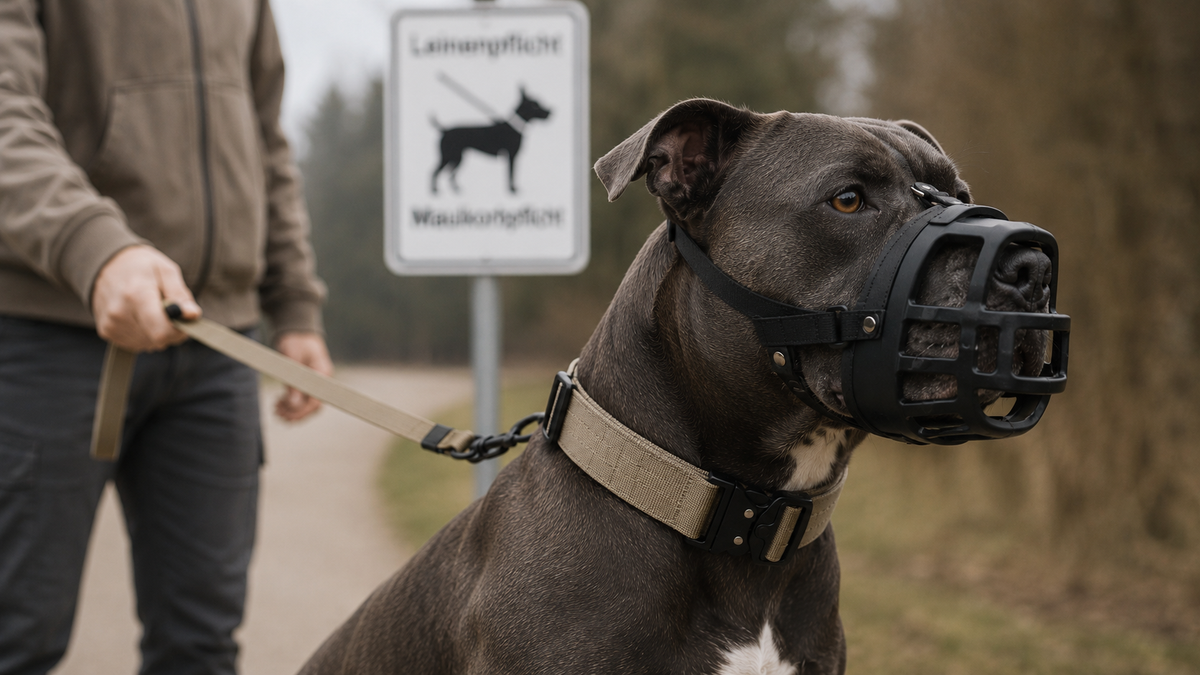
At its core, a general requirement means this: every dog, regardless of size, breed, temperament or training level, must be kept on a Leash and wear a muzzle in public. This is the maximum version that is regularly demanded in talk shows and comment sections after biting incidents.
The current legal situation in Germany is far from that — deliberately so. At federal level, the Dog Movement and Import Restriction Act (HundVerbrEinfG) of 2001 only regulates the import and movement of certain dogs. All further dog owner obligations — Leash, muzzle, proof of competence, restricted breed dog regulations — are a matter for the federal states and differ significantly.
In many cities, a general leash requirement applies in inner-city areas. In most federal states, a muzzle requirement applies only to so-called restricted breed dogs or to dogs with a documented negative official assessment. Several federal states — including Lower Saxony, Schleswig-Holstein, Thuringia and, in part, Bremen and Hamburg — have abolished or significantly reduced their breed restriction lists in recent years. Instead of the breed, the focus has shifted to dog owner competence.
The Lower Saxony model as a reference point
Lower Saxony is particularly interesting here. Since 2013, the Lower Saxony Dog Act (NHundG) has required every first-time dog owner to provide theoretical and practical proof of competence — regardless of breed. Anyone who gets a dog must prove within a set period that they understand the basics of dog behavior, husbandry and safe handling. Lower Saxony has not had a breed restriction list since 2003.
The Veterinary Association for Animal Welfare has documented several times in its leaflet 85 that blanket breed-based regulation is not scientifically defensible. The same argument can be applied to a general requirement for all dogs — except that the blanket approach is even broader there.
The view of supporters — and why it does not hold up scientifically
We understand the reflex behind the demand. Anyone who is afraid of dogs or has experienced a dog attack wants a simple protective mechanism. A general requirement sounds like exactly that simple mechanism. The problem is that it does not solve the actual issue — and the data shows this clearly.
The 2014 risk analysis by the BMU and BfR on the assessment of biting incidents reaches a clear conclusion: the likelihood of a biting incident depends much more strongly on dog owner, socialization and situational factors than on breed. Most documented incidents happen in the home environment, not on the street. A leash and muzzle requirement in public does not address those incidents at all.
For years, statistics from the insurance industry have shown a consistent picture: family dogs, often medium-sized to small breeds, are involved in a substantial proportion of reported bites — and these bites often happen to family members, frequently children, inside the home.
And finally, the international comparison. Between 1993 and 2008, the Netherlands had a nationwide restricted breed dog requirement. It was abolished in 2008 after an evaluation found no measurable effect on the number of biting incidents.
What a blanket requirement actually creates
A general muzzle requirement for all dogs would have several unintended consequences that are rarely discussed:
First: Dogs that have never been accustomed to a muzzle would experience it as a major stressor. Correct muzzle training with positive association takes weeks to months. A nationwide introduction without a transition period would put thousands of dogs into a permanently stressful situation — and stressed dogs are not safer, but often more reactive.
Second: A general leash requirement makes essential aspects of normal dog behavior impossible. Dogs need movement, social contact with other dogs and the opportunity to explore their environment. Anyone who keeps a dog exclusively on a short Leash risks lack of exercise, frustration and secondary behavioral issues — which in turn increase the risk of conflict.
Third: A blanket rule shifts responsibility away from the dog owner. The real point of influence — dog owner competence, proof of competence, early socialization — is replaced by a technical tool. That may be convenient, but it is not a safety concept. It is symbolic policy.
What research says about dog owner and situational factors
If breed explains only about 9% of behavioral variance, what explains the rest? Current behavioral research consistently points to three clusters: socialization in early puppyhood, ongoing stress or pain, and dog owner behavior — especially consistency, expectation management and the ability to read early warning signals.
A significant proportion of reactive behavior in domestic dogs is fear-based, not offensively aggressive. This means that dogs perceived as “dangerous” in public are often acting from overwhelm. A general muzzle requirement does not resolve this overwhelm — it masks it. In the worst case, it intensifies the problem because the dog also has to cope with the additional stressor of the muzzle.
This leads to a clear consequence: anyone who wants to reduce biting incidents must start with dog owner suitability, not with the dog. Proof of competence, mandatory Dog Training Academy for first-time dog owners, clear breeding controls against fearful and overstimulated lines — these are the levers that work. These levers require more effort than a sign saying “leash requirement for everyone”. But they are the only ones that research consistently correlates with fewer incidents.
Differentiated rules: what we consider sensible instead
Reasonable dog policy distinguishes by situation, not by blanket rule. From our perspective, this includes four elements.
1. Leash requirement based on the situation, not as a blanket rule
Leash requirements in inner cities, on main roads, in train stations, in nature reserves during breeding and nesting season — all of this is plausible and well justified. It is about stimulus density, other road users and wildlife protection. Leash requirements in open fields, in forests outside breeding season, in designated off-leash areas, for trained dogs with reliable recall — not plausible and counterproductive for dog welfare.
The standard should be: how high is the stimulus density and the risk to third parties? High in a pedestrian zone, low in open terrain. A well-designed rule reflects exactly this gradient.
2. Muzzle requirement based on behavioral assessment, not breed
A muzzle requirement for dogs that have attracted attention through documented behavior — a negative official assessment, a biting incident, a relevant temperament test — is sensible. A muzzle requirement in certain spaces such as public transport is acceptable and usually practical. A muzzle requirement for all dogs regardless of individual behavior is disproportionate.
Important here: the muzzle itself is not a stigma, but a valuable tool when it has been trained fairly and with positive association. Vito and Amalia are both conditioned to wear a muzzle. They wear it where it is required, without visible stress — because they know it, because it fits, because it has positive associations. But that only applies if training has taken place beforehand. A blanket requirement from one day to the next would skip exactly this training.
3. Proof of competence for first-time dog owners — based on the Lower Saxony model
Since 2013, Lower Saxony has implemented a model for what should become the nationwide standard: theoretical and practical proof of competence for every first-time dog owner, regardless of breed. Anyone who gets a dog must show that they understand the basics. This exact logic should be embedded nationwide. It starts with the dog owner, not the dog.
From our practical experience with dog owners of restricted breed dogs, we know that most problems do not arise because the dog belongs to a certain breed, but because the dog owner is not sufficiently prepared. Mandatory proof of competence does not filter breeds; it filters dog owners — and that is the more honest lever.
4. Consistent enforcement instead of new blanket bans
Existing rules — leash requirements in city centres, duty of supervision, dog owner liability, leash requirements during breeding seasons — are poorly enforced in many places. Before new blanket requirements are introduced, existing regulation should be seriously monitored and sanctioned. Symbolic tightening on paper is no substitute for a public order authority that actually checks compliance.
Our responsibility as dog owners — regardless of the law
Regardless of the legal situation, we are responsible for how our dog affects others. When we are out with Vito and Amalia, we keep distance from people who feel unsure, never approach leashed dogs with our dogs off leash, continuously read our dogs’ body language and end situations early. Amalia came to us at six months old — she had an uncertain start, and we knew from the beginning that we would need to observe her especially carefully. It is precisely this individual view that no blanket rule can provide.
We take the same approach with equipment. A Leash is not just a Leash. A Collar is not just a Collar. When we design products at Vitomalia — Collars with raised padding, ergonomic Harnesses — we think from exactly this dog owner perspective: safety begins with material that holds and a fit that does not put strain on the dog. But that does not replace dog owner competence. It complements it.
That is the uncomfortable truth often missing from the debate: most conflicts do not arise because a dog is broadly dangerous, but because a dog owner is not attentive enough. A Leash does not change that. A muzzle does not change that. Dog owner competence changes everything.
Our Vitomalia conclusion
We reject a general leash and muzzle requirement for all dogs. It is symbolic policy, not a safety instrument. It shifts responsibility away from the dog owner, ignores the research on behavioral variance (Morrill 2022), contradicts the empirical bite statistics (Petkova 2024) and creates follow-on costs for dog welfare that nobody discusses. The Dutch experience (Cornelissen & Hopster 2010) also shows that even the milder version — a breed-based requirement — brings no measurable safety gain.
What we need is differentiated, situation-based regulation, mandatory proof of competence for first-time dog owners based on the Lower Saxony model, a fairly trained muzzle as a tool rather than a stigma, and consistent enforcement of existing rules. That is less catchy than a blanket requirement — but it is the version that actually works. And it treats every dog and every dog owner as an individual, not as a suspected case.