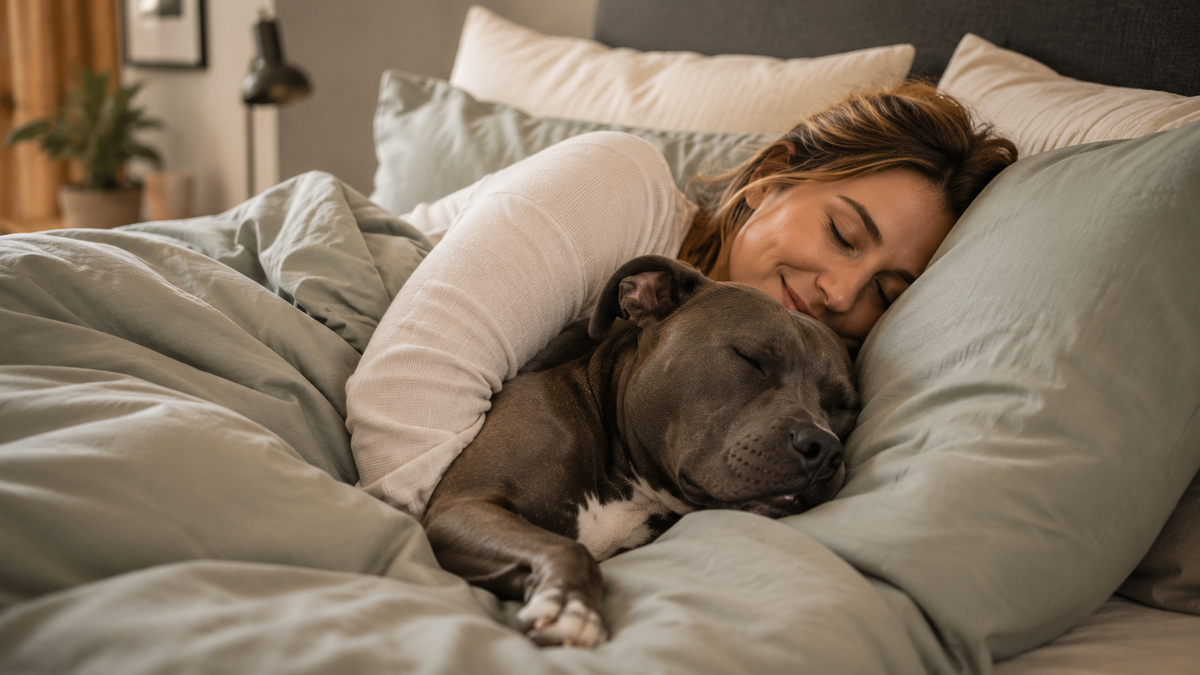
Ob Hunde im Bett schlafen dürfen, ist keine Frage von Respekt oder Dominanz. Wir schauen auf Hygiene, Schlafqualität, Bindung und darauf, wann gemeinsames Schlafen entlastet oder stört.
Introduction
The question comes up in our practice with a regularity that is almost touching: “Lui, Paulina – is our dog allowed to sleep in the bed now, or is that wrong?” Sometimes it is asked sheepishly, sometimes defiantly, sometimes as a hidden request for permission. And almost always, behind it lies a tangle of old beliefs, hygiene concerns, discussions with a partner, and a considerable amount of guilt. In this article, we want to clear things up – not with a blanket answer, but with an honest, scientifically grounded assessment. Because the truth is: the bed question is far more nuanced than the loudest voices in dog forums and training guides would have us believe.
We work every day with female and male dog owners whose dogs move from the couch to the sofa to the pillow – and with others who consistently have their dog sleep in their own area. Both approaches can work. Both approaches can fail. As so often in behavioral consultation, it depends on the individual dog, the specific human-dog constellation, and the question of what everyone involved actually needs. In this article, we look at the persistent dominance myth, what sleep research actually says, realistic hygiene risks, the bond aspect, and those situations in which, from a behavioral therapy perspective, we recommend a clear boundary.
The dominance myth: Why “dog in bed = hierarchy problem” is not scientifically tenable
Let us begin with what is probably the most common argument against having a dog in the bed: “If the dog lies higher than you, he thinks he is the boss.” This statement can still be heard today in dog schools, TV shows, and from relatives over Sunday coffee. Scientifically, it has long been disproven – and yet it remains remarkably persistent.
The original idea comes from wolf research in the 1940s, specifically from Rudolf Schenkel’s observations of wolves in captivity. These wolves – animals unfamiliar with one another in a confined space – displayed behaviors that were later interpreted as a “linear hierarchy.” The very researcher whose name was associated with the theory for decades, L. David Mech, later publicly revised his own early conclusions: free-living wolf packs are usually family groups in which parents guide their offspring – not despots defending their rank. Applied to dogs, this means: the mechanical model of “height = rank” simply has no empirical basis in the human-dog relationship.
Dogs know very well that we are not dogs. They seek closeness because they feel safe, because it is warm, because they like us. Not because they are planning to take over the apartment. Modern behavioral biology – we are thinking here of work by Bradshaw, Blackwell, and Casey – describes the coexistence of humans and dogs as a cooperative relationship, not as a constant competition over resources or sleeping places.
So anyone who bans their dog from the bed purely for hierarchical reasons is fighting a phantom. That does not mean the dog automatically belongs in the bed. It only means: the reason needs to be a different one. And that is exactly what we will look at now.
What really attracts dogs to the bed
Vito, our AmStaff, consistently occupied every soft spot that was not actively being used by us even as a puppy. Amalia, our APBT, who came to us at six months old, initially avoided the bed – trust has to grow – and only dared to climb up for the first time after weeks. Two dogs, both with a classic restricted breed dog constitution, completely different sleeping behavior. What they have in common: closeness, warmth, a slightly raised sleeping place with a good overview, and the scent of their caregivers. It is about safety and comfort, not status.
Sleep quality: What research says about co-sleeping with a dog
This is where it gets interesting, because the data is surprisingly differentiated. For a long time, it was considered a given that pets in the bedroom disturb sleep. Studies from the last ten years paint a much more nuanced picture – and in some cases the opposite.
Probably the best-known work on the subject comes from Lois Krahn and colleagues at the Mayo Clinic. They examined how the presence of a dog in the bedroom affects the sleep quality of adult dog owners. The result surprised many: dogs in the bedroom – importantly: in the room, not necessarily in the bed – were experienced by many participants as calming and sleep-promoting. Objectively measured sleep efficiency with dogs in the room was within entirely acceptable ranges. Dogs directly in the bed, however, more often led to micro-awakenings and reduced sleep efficiency.
Another study by Hoffman and colleagues adds a different perspective to the picture: among women who slept with a dog in the bed or bedroom, the subjective feeling of safety was higher and sleep was described as more restorative than among those who slept with a cat or a human partner. Subjective perception and objective sleep measurement therefore do not have to match exactly – and both have their place. Anyone who feels safer with a dog in the bed and falls asleep faster benefits in a real way, even if actigraphy shows a few additional waking phases.
What does this mean in practice? There is no clear answer of “sleep gets better” or “sleep gets worse.” There are people who sleep deeply and calmly with a dog beside them, and there are people whose sleep registers every nightly change in the animal’s position. Anyone who chronically sleeps poorly and has a restless dog should honestly assess whether sharing the bed is truly restorative or whether it is part of the problem. Sleep is the body’s most important regenerative function – dog or no dog.
When the dog is larger and stronger
One aspect that is missing from most guides: size and build play a real role. A 30-kilogram dog that lies across the bed massively changes the logistics of the bed. That is not a relationship problem; it is geometry. With strong dogs – whether AmStaff, APBT, Boxer, Cane Corso, Rottweiler, or German Shepherd – it is worth thinking realistically about the bed question from the outset. From our work, we know clients who are completely relaxed with small dogs and suddenly renegotiate everything with a fully grown restricted breed dog. That is legitimate. Nobody has to become a martyr to human-dog romance.
Hygiene and zoonoses: What is realistic and what is not
Let us come to the second major topic that is always present in the bed question: hygiene. Depending on the camp, this is either dramatized or downplayed. Both are unsatisfactory. We prefer to look at what veterinary parasitologists actually recommend.
The scientific consensus, for example from the guidelines of the European Scientific Counsel Companion Animal Parasites (ESCCAP) and the Robert Koch Institute, can be summarized as follows: zoonotic risks from dogs are real, but low in healthy, well cared-for dogs kept free of parasites. Most pathogens typical of dogs – giardia, roundworms, tapeworms, dermatophytes – can be well controlled through consistent prevention. Risk factors are less the bed itself and more inadequate deworming, unclear health status, contact with raw meat or the feces of other animals, and insufficient hand hygiene.
In concrete terms, this means: anyone who has their dog examined regularly, follows an appropriate deworming or fecal testing schedule, prevents ticks and fleas, wipes paws after walks, and washes bedding at sensible intervals carries a very manageable risk – even if the dog is allowed in the bed. Anyone who is immunosuppressed, undergoing chemotherapy, has infants in the household, or has known allergies to animal dander should handle the bed question more strictly or seek medical advice.
Pragmatic hygiene routine
We usually recommend a simple approach to our clients: an additional washable dog towel or blanket on top of the duvet, which goes into the wash every few days. Paw cleaning after walks with damp cloths or a small paw washer. Regular coat care – for short-haired dogs like our two, a weekly routine with a rubber curry brush is often enough. And a realistic veterinary schedule with parasite prevention based on individual risk assessment. This is not rocket science, but part of the responsibility of dog ownership – with or without the bed.
Bond, separation anxiety, and the risk of excessive closeness
Now we come to the point where we, as behavioral therapists, look particularly closely. Because the emotionally charged aspect of the bed question – the bond – is also the most delicate when it is assessed incorrectly.
The good news first: co-sleeping in itself does not harm the bond. On the contrary – closeness during sleep can be a stabilizing bond anchor, especially for dogs that have previously experienced insecure or changing living situations. Rescue dogs, dogs from international animal welfare, former chained dogs – they often benefit enormously from staying in immediate proximity to their new caregivers during the first weeks and months. Anthrozoology refers to this as “safe haven” behavior: the dog uses the caregiver as a safe haven from which to explore the world.
The critical point: in a subgroup of dogs – those with a predisposition or history of separation stress – exclusive closeness in bed can gradually reduce tolerance for being alone. If the dog can only relax in immediate physical proximity, every trip to the bathroom without company becomes a stressful situation. Here, the bed is not the problem; the lack of experience with distance is. We see this regularly in our practice: dogs that sleep perfectly in the bed but panic after ten minutes alone in the living room.
Our pragmatic advice from practice: observe your dog. Can they relax in their bed during the day without you? Can they stay alone in another room without whining or scratching? If yes, there is nothing against sleeping in the bed at night if you want that. If no, it would be wise to work specifically on calm, confident alone-time alongside the bed question, so the dog can enjoy closeness without tipping into dependency.
When we recommend a clear boundary
There are situations in which, from a behavioral therapy perspective, we advise clarity and declare the bed a no-go zone. They occur less often than some hardliners claim, but they do exist – and ignoring them would be careless.
First: resource guarding toward a partner or children. If the dog actively defends their sleeping place in the bed – growling, snapping, staring when someone approaches – the bed is not a shared place for the time being. This requires behavioral therapy, clear structures, and an alternative sleeping place until the resource guarding has been addressed. This is even more important with strong dogs, where a single bite incident could have serious consequences.
Second: dogs with unresolved aggression-related issues in conflict situations. Sleepy dogs react – like humans – with reduced impulse control. Anyone who steps on a paw while half asleep or wakes the dog abruptly risks a reflexive defensive reaction. With a dog with known aggression potential, this is an avoidable risk.
Third: unclear sleep disorders or illnesses in the dog. Dogs with nighttime restlessness, cognitive dysfunction syndrome in old age, pain, or frequent nighttime getting up should sleep where it is least stressful for them and for us – and that is rarely the shared bed.
Fourth: puppies before house training is established. Here, we clearly recommend first establishing house training and initially letting the puppy sleep in a sleeping crate or a Dog Bed next to the bed. Once house training is reliable – this can take eight weeks or four months, depending on the puppy – you can freely decide whether the dog will be allowed in the bed in the future or not.
Consistency is more important than the decision itself
What we most often see in consultations is not harm caused by “dog in bed” or “dog not in bed.” It is harm caused by inconsistency: sometimes the dog is allowed, sometimes not. Sometimes they are lifted up, sometimes sent away. Sometimes one partner cuddles them in, sometimes the other shoos them out. Dogs read rules through pattern recognition – when the pattern changes, uncertainty arises. So decide together, as an individual or as a couple, what applies in your home. And then stick to it. That is probably the most important recommendation in this article.
Our Vitomalia conclusion
If we summarize the bed question, it is like this: there is no universally correct answer. There is a good answer for your dog, your lifestyle, your sleeping habits, and your health situation – and you need to find it honestly. The dominance myth is settled. The hygiene risks are manageable with healthy dogs kept free of parasites. Sleep research says: pleasant for many, stressful for some. Bond research says: closeness is good – dependency is not.
This is the line we work along at Vitomalia. With Vito and Amalia, we have two dogs who sometimes sleep with us and sometimes beside us – depending on the weather, how the day has gone, and what they feel like. We consciously chose this because it suits us. But we would not advise anyone to make the same decision just because we make it. Nor would we judge anyone who consistently has their dog sleep in their own bed. Both can be responsible if handled consciously and consistently.
What we would like to see – and this is the line on which we generally work – is a dog world in which dog owners decide less according to camp opinions and more according to the specific dog in front of them. The sleeping place is a detail. The underlying attitude – seeing the dog as an individual, thinking scientifically, questioning dogmatic generalizations – is what ultimately makes the difference. Anyone who decides from this perspective rarely gets much wrong. And, we say this cautiously, probably sleeps a little more peacefully at night too.