Hundebekleidung wird oft belächelt oder romantisiert. Wir schauen auf ihre historischen Wurzeln und darauf, warum Schutzkleidung lange vor dem Lifestyle-Gedanken eine praktische Funktion hatte.
When we talk about dog clothing today, opinions are divided. Some people roll their eyes as soon as they see a dog wearing a coat and call it humanization. Others dress their animals for every kind of weather as if it were self-evident. Both sides often argue from gut feeling, and that is exactly why a sober look back helps.
Because the history of dog clothing is much older, more complex, and more functional than most debates suggest. It stretches from Egyptian pharaohs to Roman protective armor and medieval hunting equipment through to the modern outdoor industry. We take you on this journey through time and, at the end, connect it to our position at Vitomalia.
Antiquity: adornment, status, and the first real protection
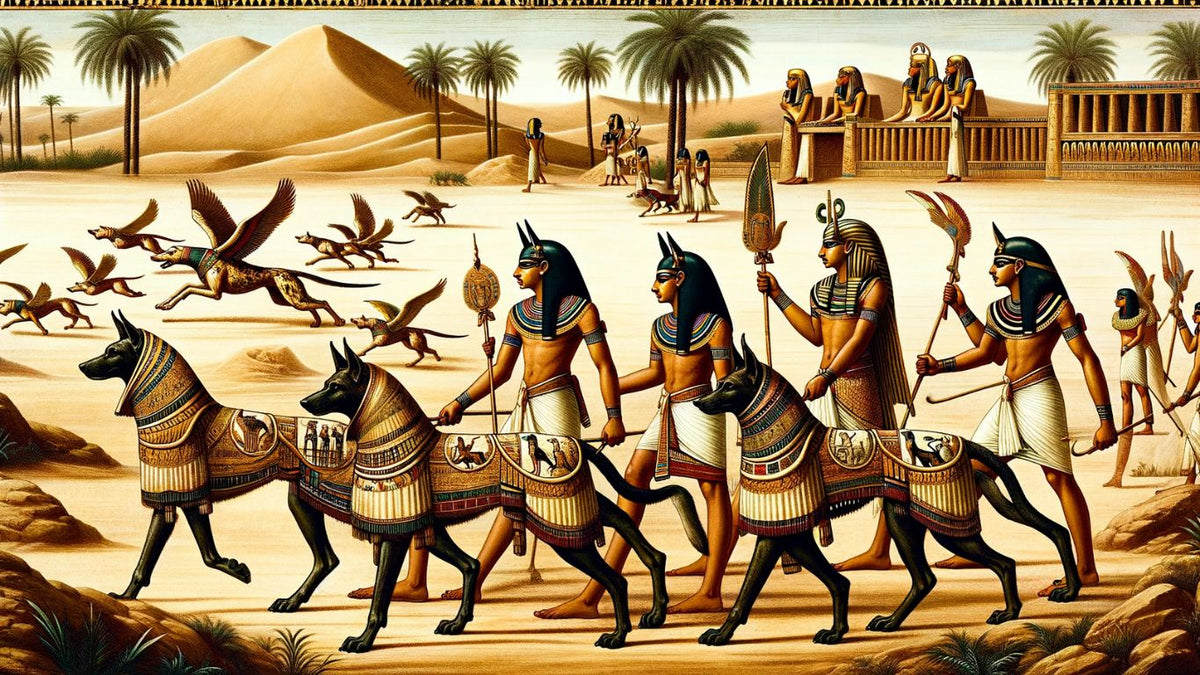
The idea of clothing or equipping a dog is not a modern invention. Even in Ancient Egypt, there is clear evidence that dogs were more than just companions. In tombs and reliefs from the Old Kingdom, for example around the Fifth Dynasty, dogs are depicted with decorated Collars and, in some cases, elaborate pieces of jewelry. These Collars were often made with bronze, leather, or painted wood and carried the animals’ names. They had a dual function: they identified the dog as property while also representing the status of its owner.
This was not purely protective clothing in today’s sense. But it is the first documented point at which people visibly equipped their dogs with ornate items that went beyond what was purely useful.
The Roman Empire: function meets toughness
In ancient Rome, the picture becomes much more pragmatic. Here we find the first clear evidence of functional protective clothing. Roman war and guard dogs, often large molosser-type dogs, were equipped with padded Collars, leather armor, and sometimes iron spiked Collars. These so-called melium were used to protect the dogs’ sensitive neck area from bites by other animals, especially in fights with wolves or when guarding herds.
What is interesting is that this equipment is described in texts such as Varro’s De re rustica and later by Columella. These sources are explicitly about function, not appearance. Anyone using a dog to protect livestock or property needed an animal that could survive. That is the historical core in which dog clothing was understood as a protective tool.
The Middle Ages: hunting dogs, protective armor, and the question of wolves
In the European Middle Ages, dog equipment developed further, driven by the central role of hunting among the nobility. Hounds, tracking dogs, and large hunting packs were significant investments. Losing them, for example to wild boar, bears, or wolves, caused real economic damage. As a result, an entire category of protective clothing developed specifically for hunting dogs.
Padded doublets made of thick linen, reinforced leather vests, and in some cases even light chainmail for particularly vulnerable areas such as the chest and flanks can be found in hunting manuals and illustrations from the late Middle Ages onward. The famous Livre de chasse by Gaston Phoebus from the late 14th century shows several versions of this kind of equipment. Collars with outward-facing spikes, which we might see today as a historical curiosity, had a very serious purpose at the time: they were intended to deflect a wolf’s or wild boar’s bite to the neck.
What this tells us about the argument of humanization
When we hear sweeping claims today that dog clothing is a modern form of humanization, it is worth taking a second look. Across at least two thousand years of documented history, people have put protective clothing on their dogs because the situation required it. This was not sentimentality. It was a practical tool for an animal that played an important role in people’s everyday lives.
For us, this matters because it puts some perspective on the emotional charge in today’s debate. Historically, the question was never whether clothing was allowed. The question was always: do you really need it here?
Victorian England: the shift toward fashion
In the 19th century, the logic changed radically. In Victorian England, a society with a rising middle class, high levels of consumption, and growing affection for animals as a social value, the dog increasingly became a companion in the living room. Queen Victoria herself was known for her love of dogs and at times had dozens of dogs, which she also presented publicly. The first documented Dog Coats that primarily signified style rather than protection date from this period.
Dressmakers made small vests from velvet, brocade, or wool, often color-coordinated with the dog owner’s clothing. The first dog boutiques appeared in London and Paris, and fashion magazines of the time featured dogs with elaborate bows, collars, and capes. This marks the real turning point: clothing changes from a tool into a status symbol.
Industrialization and the 20th century: function returns
Alongside Victorian fashion, a second strand developed. During industrialization, dogs continued to be used in working contexts, from police and military dogs to rescue and service dogs. Functional clothing remained present here: bulletproof vests, reflective Harnesses, insulating coats for avalanche dogs. In the 20th century, the first outdoor brands finally emerged that specialized specifically in dog clothing. Providers such as Ruffwear, Hurtta, or Kurgo, which we mention here only as examples of market development and explicitly do not recommend, represent a second wave: the return to function, this time within a consumer context.
Materials such as breathable membranes, technical padding, and reflective fabrics were adapted from outdoor clothing for humans. This created a market segment that argues from a functional perspective while also strongly benefiting from the lifestyle trend surrounding the outdoors and dogs.
Pet humanization as a market phenomenon
This is exactly where two lines intersect. The American Pet Products Association and comparable European associations have been reporting for years on the phenomenon of pet humanization. This means that dogs are increasingly treated like family members, with their own birthdays, insurance, specialized food, and, of course, clothing. The market for dog clothing is growing accordingly, and studies such as the APPA’s annual reports show that spending on clothing and accessories per dog continues to rise.
This is neither inherently good nor inherently bad. It is a shift we need to understand if we want to know why so much dog clothing exists today that has little to do with the original idea of protection.
Two camps today: function or staging
When we bring the history together, we essentially see two camps today. On one side is the functional line, rooted in antiquity, the Middle Ages, and 20th-century workwear. This is about protection from cold and wet conditions, visibility in the dark, and support for dogs with short coats, low body mass, or health limitations. On the other side is the decorative line, which began in the Victorian period and continues today in the form of fashion coats, Halloween costumes, and boutique outfits. It primarily satisfies a human need for staging.
Both lines are real, and both are marketed side by side in retail. That is exactly why it is harder today than it used to be to distinguish what benefits the dog from what does not. If you want to address the practical question of whether your own dog needs a coat, you will find the specific criteria in our article Does my dog need a Dog Coat? This article is the history; the other one is the practice.
Our Vitomalia conclusion
At Vitomalia, meaning Lui as a dog behavior therapist and Paulina as a canine scientist, we find the historical perspective so valuable because it takes the heat out of today’s debate. Dog clothing was never exclusively fashion and never exclusively protection. It has always been both, shifting more strongly in one direction or the other depending on the era.
For us, this leads to a clear position. If clothing is used, it should be functional. We look for tested materials, breathable fabrics, anatomical cuts that do not rub in the armpits or neck area, and full freedom of movement for the shoulders, spine, and tail. Vito and Amalia, our own dogs, wear functional clothing in wet and cold weather or after water work. They do not have fashion coats, and we do not miss them.
History shows us that there is an honest, old tradition of equipping dogs with what protects them. That tradition is worth continuing. But it is not the same as what the pet industry sometimes sells us today. Keeping this difference in mind is, for us, the real value of this journey through time.