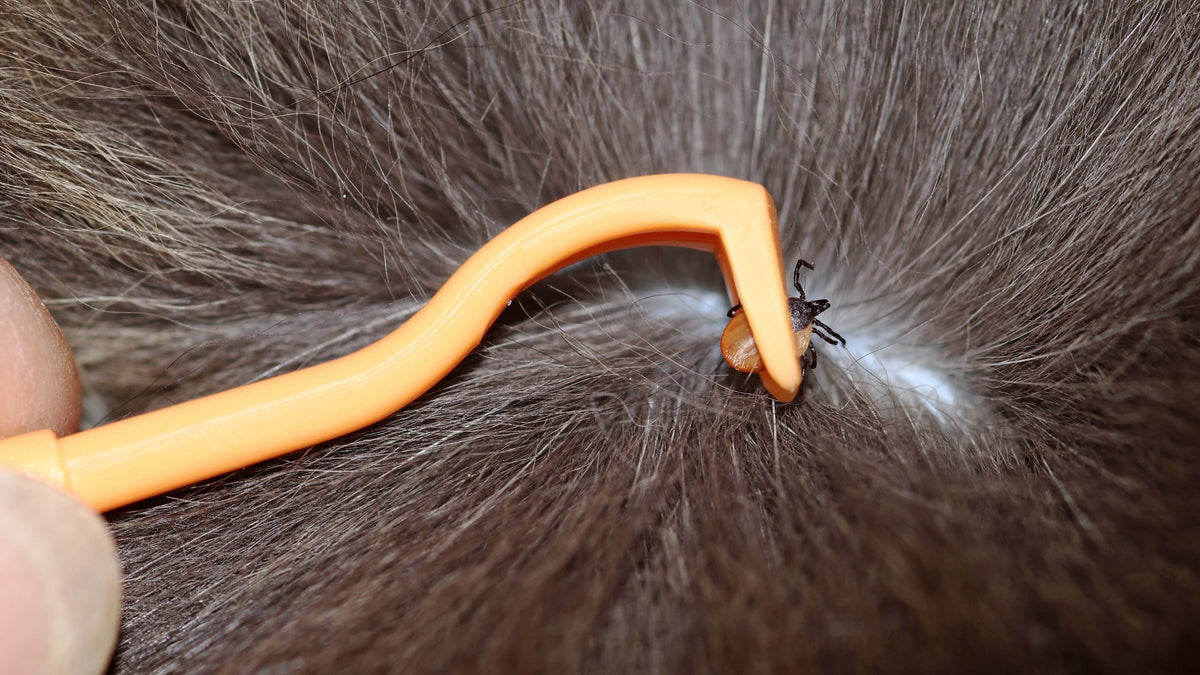
Zecken zu entfernen ist kein Hexenwerk, aber Hektik und Hausmittel machen es oft unnötig kompliziert. Wir erklären, worauf es technisch ankommt und wann Beobachtung wichtig wird.
A tick on your dog is not a disaster, but it is not something to ignore either. How it is removed has a direct impact on how high the risk is that pathogens may be transmitted. That is exactly why it is worth thinking through the process calmly before you find the first tick of the year in your dog’s coat.
At Vitomalia, we receive more questions about ticks than almost any other topic: Twist or pull? Apply oil or not? Tick hook or tweezers? And above all: how serious is it really if you do not do it perfectly once? In this article, we want to sort through the research, put the most important recommendations into context, and transparently share our own routine with Vito and Amalia.
This article is part of our tick series. It complements our articles on tick species, transmission pathways, and prevention, and deliberately focuses on the moment that comes up most often in everyday life: the tick is already attached, and it needs to come out.
Why timing matters
Early removal is the most important factor we can influence ourselves as dog owner.
What does that mean in practice? It does not mean you need to panic if a tick has been missed for a few hours. But it does mean that removing it earlier generally reduces the risk, not only for Lyme disease, but also for many other relevant pathogens.
What this means for everyday life
Based on this evidence, we at Vitomalia draw a very simple conclusion: after every walk in risk areas, we do a brief check. Not every single hair, but the ears, neck, armpits, belly, inner thighs, and spaces between the toes. With Vito and Amalia, this takes about two minutes because they have known being gently checked by touch since puppyhood. This exact kind of cooperative participation can be trained and makes the difference between routine and a stressful moment.
How to remove a tick correctly
This is where it becomes technically interesting, because recommendations have shifted slightly in recent years. The key guidelines come from the CDC in the United States and the European expert group ESCCAP, which focuses specifically on parasites in dogs and cats. In principle, both arrive at the same recommendation, with small differences in detail.
The core point is always the same: grasp the tick as close to the skin as possible without squeezing its body, then remove it with controlled, steady traction. What has changed is the old rule of thumb to “always twist.” It comes from a time when tweezers were mainly used, and it is not universally correct.
Tweezers: straight pull
If you use fine, pointed tweezers, you should grasp the tick as close to the skin as possible and slowly pull straight upward. This matches the current CDC recommendation. Twisting with tweezers is more likely to be counterproductive, because it can easily squeeze the tick’s body, which may release saliva and potentially pathogens into the wound. The pull should be slow because quick jerking is more likely to tear off the mouthparts.
Tick hook: gentle twisting motion
With a tick hook, the situation is different. The geometry of the hook is designed so that a gentle twisting motion levers the feeding apparatus out of the skin without squeezing it.
Tick card: only with limitations
Plastic cards with a wedge-shaped notch are better than fingernails in an emergency, but they have limitations. With very small ticks or in dense fur, precise positioning is difficult, and the risk of squeezing the tick’s body is greater than with a fine hook. We consider the card an emergency solution, not a standard tool.
What is not an option
There are a number of home remedies that persist, and we want to name them clearly here because they increase the risk instead of reducing it. Oil, glue, nail polish, alcohol, burning – all of these have one effect in common: the tick becomes stressed, and stressed ticks regurgitate, meaning they release stomach contents and saliva back into the wound. This is exactly the moment when the risk of pathogen transmission rises significantly. This mechanism has been described for decades.
Squeezing with your fingers or with coarse tweezers also belongs in this category. If pressure is applied to the tick’s body, exactly what we want to avoid can happen. The only method that is truly well supported is mechanical removal close to the skin, with as little pressure as possible on the tick’s body.
After removal
Once the tick is out, the second part begins, and it is at least as important as the removal itself.
The bite site should be cleanly disinfected, for example with a wound disinfectant suitable for dogs. We note the date, ideally with the location – “Wednesday, right armpit.” That may sound excessive, but with several dogs or several ticks per season, it is worth its weight in gold if symptoms appear weeks later and the veterinarian asks.
We do not simply throw the tick in the trash. We keep it for a short time, either in a small sealable plastic bag or on a strip of tape attached to a piece of paper. If the dog shows any concerning signs in the following weeks, the tick can be used for laboratory testing for pathogens.
What we watch for in the following weeks
The critical phase is not the day of removal, but the following one to four weeks. We pay attention to:
- Changes at the bite site: local redness in the first one or two days is normal; a spreading, ring-shaped redness, known as erythema migrans, is rarer and harder to see in dogs than in humans, but possible
- Changes in general behavior: lethargy, loss of appetite, fever, joint stiffness, sudden lameness that appears in different places
- Abnormalities in urine or mucous membrane color that may indicate babesiosis
None of these symptoms is a reason to panic, but they are a reason to see the veterinarian, ideally with the information “tick bite on date X.” That saves diagnostic time.
Our routine with Vito and Amalia
We try to keep the whole topic as uneventful as possible. During the risk months, the brief tick check is part of the evening routine, just like wiping paws. Vito and Amalia have known this since puppyhood, so it is not an intervention, but routine.
For the removal itself, we prefer to work with a fine tick hook, simply because it is forgiving and also works for small nymphs. The tweezers are ready alongside it in case a tick is attached in a spot where the hook is difficult to position. We speak calmly to the dog during the process, avoid sudden movements, and if the dog seems unsure, we pause briefly and restore calm. A tick is not going to run away.
And yes, we make mistakes. A tick occasionally breaks off for us too, and even then, the same applies as what we advise ourselves: disinfect the area, observe, and if in doubt, go to the veterinarian. The body usually pushes out retained mouthparts on its own; a bloody intervention immediately afterward is rarely necessary.
Our Vitomalia conclusion
Correct tick removal is not a mysterious science, but it does have a clear scientific core: remove early, work cleanly and mechanically, do not squeeze the tick’s body, do not use home remedies, and stay attentive in the following weeks.
What has changed compared with older recommendations: the blanket advice to “always twist” no longer applies universally today. It depends on the tool. With tweezers, you pull straight; with a tick hook, you may and should twist gently, because its geometry is built precisely for that.
And perhaps the most important point: a dog who is familiar with touch and has learned to calmly cooperate makes the entire process easier and safer. This is not a training topic for the acute moment, but something that runs alongside everyday life. It is exactly there, in everyday life, that it is decided whether ticks remain a drama or become a routine that is barely noticeable.