Ein gutes Halsband fällt im Alltag kaum auf, weil es weder rutscht noch drückt. Wir erklären, warum Passform mehr ist als Komfort und wie aus kleinen Fehlern schnell Dauerbelastung wird.
A Collar is one of the few pieces of equipment a dog wears practically every day — in the garden, on walks, in the car and sometimes even at home. Precisely because it sits so naturally around the neck, a poor fit is often noticed only late. As long as nothing is obviously rubbing or slipping, we humans tend to assume reflexively that everything is fine. For the dog, however, even a small, persistent mismatch in fit can become a quiet source of strain — in a body area that is among the most sensitive of all.
At Vitomalia, we encounter this question every day: in our own training work with restricted breed dogs, in conversations with dog owners and, of course, with our own dogs Vito and Amalia, both of whom wear premium Collars in structured everyday life. What we have learned is that fit is not something you adjust once and then forget. It is an ongoing check between canine anatomy, material, season, strain and training situation. In this article, we show you what really matters, which studies support the recommendations and how you can check the fit on your own dog step by step and with precision.
If you are still fundamentally wondering whether a Collar or Harness is the right choice, you will find the equipment decision in our separate article on that topic. Here, we deliberately take a closer look at the fit itself — the factor that determines comfort and safety once the decision in favor of a Collar has been made.
Why fit around the neck is so sensitive
The dog’s neck is anatomically highly complex. The trachea, thyroid gland, carotid arteries, lymphatic vessels, nerve pathways and cervical spine all sit within a very confined space, surrounded by muscles the dog constantly uses for head posture, breathing and expression. If a Collar applies constant pressure here, rubs or tilts unfavorably, it affects more than the skin. It can influence breathing, circulation and even behavior.
The frequently cited study by Pauli and colleagues (2006) showed that strong pulling on the Collar measurably increases intraocular pressure, meaning pressure inside the eye. This is especially relevant for dogs with pre-existing eye conditions, but it also reflects a basic principle for all dogs: what happens at the neck does not stay at the neck. Carter and colleagues (2020) expanded on this with force measurements showing how high localized strain on Collars can actually become under real leash conditions, and that pressure distribution depends decisively on how wide the Collar is and how evenly it lies against the neck.
For us, this leads to a clear position: a Collar may be worn by a healthy dog – if it fits, if it is wide enough, if it is properly padded, and if Leash handling is appropriate to the level of strain. This is exactly why we made the anatomical, raised inner padding and a deliberately wider contact surface fixed design features of our Collars. They are not a style element, but a direct answer to the question of how pressure can be distributed.
Which types of dogs benefit most
Strong, muscular dogs – including many restricted breed dogs we work with every day – generate higher forces on the Collar simply because of their body mass. Sensitive, finely built dogs, on the other hand, often react more clearly to small pressure points because there is less muscle to cushion the Collar. Both speak in favor of a well-considered fit rather than the narrowest, most visually unobtrusive Collar possible.
Dogs with very dense coats are a category of their own. A Collar that initially fits well can suddenly become too loose after a coat change – or, conversely, sit tighter again in the winter coat. If you do not check this regularly, you risk exactly the kind of poor fit that becomes a constant source of strain in everyday life.
The two-finger rule and what it really means
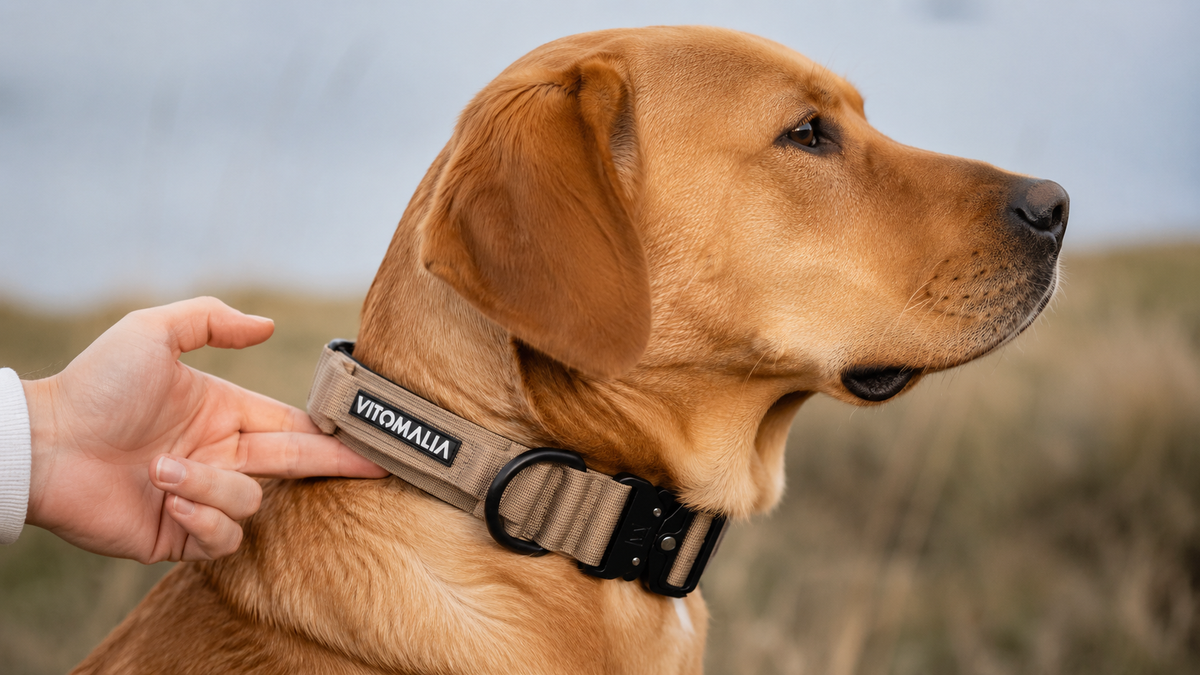
The best-known rule of thumb for Collar fit is the two-finger rule: two flat fingers should fit comfortably between the Collar and the dog’s neck – not forced in, and not with enough room for three fingers. This rule is not marketing, but a practical standard that has become established in veterinary and training practice because it creates a balance between two opposing risks.
On one side is the safety risk: a Collar that is too loose can slip over the head – especially with wedge-shaped heads, during sudden scares, or when a dog backs out of it. On the other side is the strain risk: a Collar that is too tight puts constant pressure on the trachea, lymphatic pathways, and skin, even when the Leash is not involved. The two-finger rule deliberately sits between these two extremes.
How to check the fit correctly
We always check the fit on a dog who is standing calmly – not lying down, and not sitting with the head tilted downward, because that changes the neck measurement. Slide your fingers flat, not stacked, from above between the neck and the Collar. If you cannot fit either finger in, the Collar is too tight. If three fingers slide through loosely, it is too wide.
The position of the check is important: we check at the side or upper part of the neck, not directly on the throat, because the trachea reacts particularly sensitively there. And we check several times throughout the day — once in the morning, once after movement, ideally also after moisture or play. If you only check once in a Collar’s lifetime, you miss the changes that everyday life brings.
Why height on the neck matters
A Collar should sit roughly in the upper third between the base of the ear and the shoulder blade — not low down on the throat, where every Leash impulse acts directly on the trachea. In this higher position, it rests on more stable musculature, distributes forces more favorably, and is far less likely to twist under tension.
For many dogs, the Collar shifts into a lower position on its own in everyday life — simply through movement, shaking, or Leash pressure. This is exactly where construction matters: a strap that is too narrow and too smooth slips more easily than one that has more inherent stability thanks to its width and a structured inner side.
Width, padding, and material — the underestimated factors
When we talk to dog owners about fit, the discussion often focuses only on circumference. Yet width, padding, and material are at least just as important. They determine how the unavoidable load on the neck is distributed — and whether a Collar rubs during movement or stays calmly in position.
Why width distributes pressure
Physically, it is simple: the same force acting over a narrow surface creates significantly higher point pressure than over a wide one. A thin leather strap transfers a Leash impulse almost like a cord — the entire load is concentrated on just a few square centimeters. A wide-cut Collar absorbs the same force and distributes it across a much larger contact surface, so that no single point is overloaded.
In a pressure distribution study on dogs’ necks, Hunter and colleagues (2019) were able to show that narrow straps under tension cause significantly higher local peak pressures than wider-cut models. For us, this is one of the reasons why we deliberately use a wider contact surface for our Collars — not for design reasons, but because physics leaves no other option if you want to minimize pressure on the neck.
What good inner padding does
Beyond width, the inside of the Collar determines how the material feels on the skin. A smooth, hard inner surface can rub even when the fit is correct, because it pulls minimally across the skin with every movement. Soft, unstructured padding, on the other hand, often compresses flat, loses its function, and can become uncomfortable when wet.
That is why our Collars use anatomically shaped, raised inner padding. At first, this may sound like a detail, but in everyday use it has a noticeable effect: the raised padding elements ensure that the entire surface does not lie flat against the skin. Instead, small air channels are created, reducing friction, helping sweat and moisture dissipate more effectively, and keeping the Collar more stable in its position overall. At the same time, the contact surface remains large enough to avoid pressure peaks — exactly the combination we need in practice.
Material: skin-friendly, durable, suitable for everyday use
The material determines how a Collar performs over months and years. In wet conditions, inexpensive synthetic straps often become stiff, start to rub, and deform under strain. High-quality materials — whether leather or technical fabrics — keep their shape, remain skin-friendly, and age in a controlled way. For our own Collars, we deliberately use premium materials because we want to see the same straps in use on our own dogs for a long time, not replace them after six months.
The fastener is part of the material too. A good fastener is secure under load, yet can be opened with one hand without catching fur. Pinching happens especially in heavily coated dogs — a point that rarely appears in product descriptions, but can quickly become a source of frustration in everyday use if it is overlooked.
Changing fit — why readjustment is part of it
A good fit is not a one-time state, but an ongoing process. Dogs change — and with them, the way a Collar fits changes too. Once you understand this, it becomes easier to assess when a Collar needs to be readjusted or replaced.
Young dog: growth needs attention
In young dogs, neck circumference can change noticeably within just a few weeks. A Collar that fit perfectly last month can suddenly be too tight — or the next hole may be too loose. During the growth phase, we check the two-finger rule much more often, at least weekly, and when buying, we allow for several hole positions to remain genuinely usable. A Collar that only fits on the outermost or innermost hole is not a well-fitting Collar; it is a sign that the next one is due.
Coat change and seasons
Twice a year, most dogs’ coat volume changes noticeably. In a summer coat, a Collar often sits one position tighter than in a winter coat – sometimes more, sometimes less, depending on the breed. After the coat change in spring, it is therefore a good moment for a deliberate fit check. After winter, too, when many dogs gain a little weight due to reduced activity, it is worth taking an honest look at whether the band still sits properly.
Moisture, training, daily condition
A wet Collar fits differently from a dry one – some materials swell, others contract. After intensive training or play, the neck muscles are slightly tense, which changes the circumference minimally. These daily fluctuations are normal and are a reason to choose a Collar with enough adjustment range, not a band that only just fits in the tightest hole.
Common fit mistakes and how we avoid them
In our work with restricted breed dogs and when advising other dog owner, we repeatedly see the same mistakes – not out of carelessness, but because the logic of fit is not always intuitive. If you know the typical pitfalls, you can avoid them more reliably.
Too loose out of sympathy
Many dog owner deliberately leave the Collar loose because they do not want to “constrict their dog’s neck.” That is understandable, but it turns into the opposite: a band that is too loose slips into the lower neck area, where it puts much stronger pressure on sensitive structures and, in a serious situation, may even be pulled over the head. Loose is not the same as gentle – on the contrary, a clean, proper fit is almost always more relieving.
Too tight because of safety concerns
The other side of this is the concern that the dog might slip free. If you tighten the Collar too much for that reason, you create constant pressure that the dog can hardly communicate outwardly. The two-finger rule helps here as an objective reference point. safety does not come from tightness, but from the right construction: width, padding, position on the neck, and a fastening that truly holds.
The wrong material for the wrong dog
A narrow, visually decorative band may be acceptable for a calm, lightweight dog – but for a strong dog that pulls into the Leash even occasionally, it is functionally unsuitable. We recommend always thinking of the Collar in relation to the actual dog, not an ideal image. Anyone handling a muscular, reactive, or easily startled dog will benefit far more from a wide, well padded design than from a delicate look.
Adjust and forget
The most common mistake is also the least noticeable: adjusting it once and then never checking it again. We recommend consciously integrating the fit into your routine—for example, when trimming nails each month or on the first day of every month. A brief visual check and the two-finger check take less than a minute and catch exactly the gradual changes that would otherwise be missed.
Vito and Amalia—two dogs, two adjustments
Our own dogs show very clearly how different fit can look in practice. Vito is powerfully built, muscular, and generally relaxed in everyday life. For him, a classic wide Collar with a generous contact surface works best—the construction distributes forces reliably, even if he suddenly moves into the Leash, and his calm baseline behavior means the fit remains stable for months.
Amalia has a finer build and reacts much more sensitively in certain situations. For her, we use a similar construction—wide, anatomically padded, high-quality material—but we adjust the fit more precisely and check it more often. What is a monthly visual check for Vito is more of a weekly assessment for Amalia, because her neck responds more sensitively to small changes. Both dogs benefit from the same basic philosophy, but with individually different fine-tuning.
This exact experience with two very different dogs has strongly shaped the way we think about Collar construction. It is also why, at Vitomalia, we consistently focus on a wide contact surface, anatomically raised inner padding, and high-quality materials—because we know how different dogs can be and how much the construction matters once everyday life comes into play.
Our Vitomalia conclusion
fit is not a minor detail; it is the true core of a good Collar. It determines whether the band remains a neutral piece of equipment or becomes a quiet, constant source of strain. The two-finger rule, the correct position on the neck, a sufficiently wide contact surface, and well-designed inner padding are not matters of style, but the tools we use to distribute pressure, prevent friction, and create safety.
We hope more dog owners come to see fit as an ongoing process—with a short routine, an honest eye, and the willingness to readjust when the dog, coat, or season changes. A good Collar is barely noticeable in everyday life because there is nothing that needs to stand out. That is exactly the goal: a band that holds securely, protects the dog, and gives the dog no reason to notice it at all. Vito and Amalia show us this every day—and it is the standard by which we measure our own products, too.