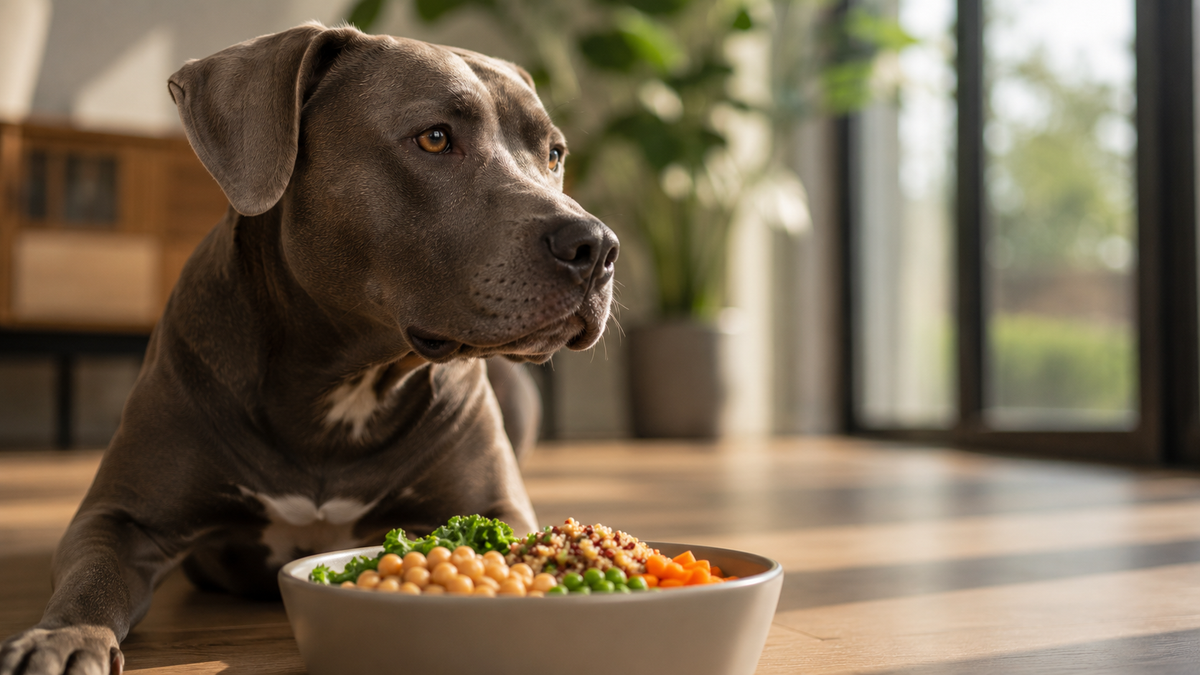
Die Frage nach veganer Hundeernährung ist ethisch aufgeladen und fachlich komplex. Wir ordnen ein, welche Argumente tragfähig sind, welche Risiken real bleiben und warum Ideologie keine Rationsberechnung ersetzt.
Hardly any nutrition topic is as polarizing as vegan dog feeding. On one side are ethically motivated dog owners who want to live their values consistently. On the other are voices that reflexively label every plant-based ration as animal cruelty. Both sides rarely argue from research, and often from emotion. That is exactly why a calm, expert assessment is needed.
In this article, we want to clearly separate three things: the ethical motivation, the nutritional feasibility, and practical implementation in everyday life. Because the question “Is it ethical to feed dogs a vegan diet?” can only be answered responsibly if we also ask: Is it possible to meet their needs, and if so, under what conditions?
Our position upfront: we are neither dogmatic advocates nor blanket opponents. We follow what international guidelines such as the WSAVA Global Nutrition Guidelines and the FEDIAF Nutritional Guidelines define as the standard. And what the current body of research actually supports, beyond social media oversimplifications.
Is the dog even a carnivore? What digestive physiology tells us
One of the most persistent assumptions in the debate around dog nutrition is: “The dog descends from the wolf, so it is a meat-eater, so meat belongs in the bowl.” This chain of reasoning sounds logical, but it is not scientifically tenable. Modern genetics paints a much more nuanced picture.
AMY2B gene duplication: domestication changed the dog
One of the most influential studies on this comes from Axelsson and colleagues, published in 2013 in Nature. The researchers showed that, compared with wolves, dogs have significantly more copies of the AMY2B gene, which encodes the digestive enzyme pancreatic amylase. While wolves typically carry two copies, dogs can have up to 30, depending on the population. In practical terms, this means dogs are biologically much better at digesting starch, and therefore plant-based carbohydrates, than their wild relatives.
This is exactly the key difference from cats. Cats are obligate carnivores. They cannot synthesize certain amino acids such as taurine and arachidonic acid sufficiently on their own and are strictly dependent on animal sources. In dogs, the metabolic situation is different: They can produce taurine themselves from the precursor amino acids methionine and cysteine, provided these are present in sufficient quantity and quality.
Why “omnivorous” does not mean “can be fed anything”
This digestive-physiological classification is often misused in the debate. Some conclude from it: “If the dog is an omnivore, you can feed it vegan without any problems.” That shortcut is wrong. Omnivorous means that the species is fundamentally able to utilize both plant and animal food. It does not mean that every ration from every source automatically meets the dog’s needs.
The FEDIAF Nutritional Guidelines list more than 37 essential nutrients that an adult dog needs every day in defined amounts and in bioavailable form. From a purely nutritional-physiological perspective, whether these come from animal or plant sources is secondary. What matters is that they are present in sufficient concentration, in the right ratio, and in a form the dog can actually absorb.
What the current state of research on vegan dog feeding really shows
In recent years, several frequently cited studies on plant-based dog feeding have been published. In the debate, they are often treated either as evidence that it “works without problems” or as “methodologically worthless”. Both views are too simplistic. We look at the most important studies and put into context what they do and do not show.
Dodd et al. 2022: dog owner report, but owner reports have limits
In 2022, the research group led by Sarah Dodd published an online survey of around 2,500 dog owners in PLOS ONE. The dog owner subjectively reported predominantly good or improved health parameters with plant-based feeding. At first glance, this sounds like a strong argument for the vegan position.
However, the methodological limitation is considerable. Dog owners who feed their dogs a vegan diet are generally highly motivated, observe closely and tend to confirm positive outcomes. Clinical outcomes, blood panels, echocardiography or long-term data were not collected. The study therefore shows what dog owners perceive, not what is objectively happening in the dog.
Knight et al. 2022: comparison of feeding types
A second, also widely cited paper by Andrew Knight and colleagues compared conventionally fed, raw-fed and vegan-fed dogs in 2022 in PLOS ONE, using several indicators such as veterinary visits, medication use and dog owner assessments. In the pooled analysis, the vegan-fed group performed more favorably than the conventionally fed group in some indicators.
Here, too, the following applies: this is an important indication, but not definitive proof. The study cannot say whether the dogs were healthier because of the vegan diet or because their dog owners are generally more committed, attentive and health-conscious. This is a classic confounder problem that is fundamentally difficult to resolve in dog owner surveys.
Domínguez-Oliva et al. 2023: the review as a sober overview
A highly worthwhile review by Domínguez-Oliva and colleagues from 2023 summarizes the current state of research on plant-based dog feeding. The authors reach a nuanced conclusion: adequate nutrient supply through plant-based rations is possible in principle, but it depends critically on formulation, raw material quality, bioavailability and supplementation. They explicitly identify the risk nutrients that matter.
The critical nutrients: where practice falls short
When vegan dog feeding goes wrong in everyday practice, it almost always fails at the same points. Knowing them is the prerequisite for having a truly informed discussion.
Amino acids: taurine, L-carnitine, methionine and cysteine
Taurine is not essential for dogs, but in certain breeds and under certain conditions it can become a critical factor. The U.S. Food and Drug Administration (FDA) has been investigating a possible link between certain diets and dilated cardiomyopathy (DCM) since 2018, particularly in predisposed breeds such as Great Danes, Boxers, Cocker Spaniels, or Golden Retrievers. The data is not yet conclusive, but the concern should be taken seriously. A vegan ration without an adequate supply of methionine and cysteine, or without taurine supplementation, can be a risk factor here.
L-Carnitine plays a role in the energy metabolism of the heart muscle and occurs naturally primarily in muscle meat. In purely plant-based rations, it must be supplemented. Methionine and cysteine, the sulfur-containing amino acids, are often limiting in plant-based protein sources and require targeted combination or supplementation.
Vitamin B12 and vitamin D
Vitamin B12 is available in a usable form practically only in animal products. In a vegan ration, supplementation is mandatory, not optional. Vitamin D is also critical for dogs: dogs cannot produce vitamin D through the skin to any significant extent; they rely on intake through food. Plant-based vitamin D2 is utilized much less effectively by dogs than animal-based vitamin D3, which is traditionally obtained from lanolin or, more recently, from special lichen cultures.
Omega-3 fatty acids EPA and DHA
The discussion around omega-3 is often oversimplified. Plant-based omega-3 fatty acid is ALA, for example from flaxseed oil. Dogs can convert ALA into the effective forms EPA and DHA only to a very limited extent. These, however, are particularly relevant for puppies, pregnant females, older dogs, and dogs with inflammatory conditions. In a well-planned vegan ration, EPA and DHA therefore come from algae oil, not from flaxseed oil. This is a common practical mistake.
Minerals and bioavailability
With iron, zinc, and in some cases calcium, it is not only the amount that matters, but also bioavailability. Plant-based iron is mostly present as non-heme iron and is absorbed less efficiently. Phytates in legumes and grains can further inhibit the absorption of zinc and iron. A reliable vegan ration must take these interactions into account both in its calculations and in the choice of raw ingredients.
What WSAVA, FEDIAF, and AAFCO specifically require
When we look for reliable reference points in canine nutrition, it is worth looking at the established guidelines. They are not ideological, but professional. And they make the debate verifiable.
The WSAVA criteria as a filter for every ration
In its Global Nutrition Guidelines, the World Small Animal Veterinary Association sets out clear requirements for manufacturers: in-house animal nutrition experts with academic qualifications (PhD in animal nutrition or board certification by ECVCN/ACVN), controlled feeding studies instead of recipe compliance alone, transparent quality control, and clear accessibility for veterinarians. These criteria apply regardless of whether a food is conventional, grain-free, or vegan. They are a useful filter for separating marketing from substance.
FEDIAF as the European basis for nutritional requirements
The FEDIAF Nutritional Guidelines define the minimum and safety levels of all essential nutrients for maintenance, growth, and reproduction. They are the standard against which every industrially produced ration in Europe must be measured. A vegan ration that is formulated in line with FEDIAF and confirmed by independent analysis is, from a professional perspective, on a different level than a homemade plant-based menu put together at the kitchen table.
AAFCO and the difference between formulation and feeding trial
The US-based AAFCO distinguishes between rations that meet nutrient requirements only by formulation and those that have additionally been tested in standardized feeding trials. For sensitive areas such as growth or reproduction, feeding-trial validation is significantly more meaningful. This is exactly where one of the weaknesses of many vegan Dog Food products lies: most are formulated, but have not been tested in long-term feeding studies. This is not an exclusion criterion, but it is an important indication of an existing data gap.
For whom vegan feeding is particularly critical
Even though plant-based rations are possible in principle, there are life stages and situations where particular caution is required. In these cases, we would either advise against them entirely or proceed only with close veterinary and nutritional supervision.
Puppies and juvenile dogs during growth
During growth, the requirements for protein quality, amino acid profile, calcium-phosphorus ratio, and DHA are especially high. Mistakes in this phase are often irreversible. Feeding “roughly balanced” is not enough here. For puppies, especially large-breed puppies, we do not recommend homemade vegan mixes, and only recommend commercial food that is explicitly formulated for this life stage and, ideally, validated by a feeding trial.
Pregnant and nursing females
Here, too, peak nutritional requirements are enormous. Amino acids, EPA and DHA, B vitamins, and trace elements have to be precisely balanced. In our view, an experimental vegan phase during this stage of life is not professionally justifiable.
Dogs with pre-existing conditions or breed predispositions
In dogs with heart disease, especially with a predisposition to dilated cardiomyopathy, chronic intestinal disease, pancreatic disease, or complex allergies, a vegan approach needs particularly careful evaluation. The rule here is: nothing without veterinary diagnostics, blood work including taurine status, and clear follow-up monitoring. Anyone who wants to switch a dog with a pre-existing condition should not decide based on a YouTube tutorial, but after consultation with a veterinarian with advanced training in veterinary nutrition.
Sensitive dogs in everyday life
We know this from our own everyday life with dogs, too. Vito, our American Staffordshire Terrier, and Amalia, our female American Pit Bull Terrier, are both muscular, performance-oriented dogs with a high need for activity. Even if vegan feeding were theoretically possible, we would set a very high threshold for switching dogs like these and insist on close ongoing monitoring. Not because of ideology, but because the margin for error is smaller in dogs with intensive physical demands.
The ethical level: nuanced rather than absolute
Back to the original question. Is it ethical to feed dogs a vegan diet? We believe the question is framed incorrectly if it allows only one answer. Ethics in animal care is never one-dimensional. It includes at least three levels that influence one another.
Level 1: The animal ethics of the individual dog
The dog owner’s central responsibility is first to the individual animal in front of them. That dog’s need for nutrients, health, and quality of life is not negotiable. If a form of feeding puts those needs at risk, it is ethically problematic for that dog, regardless of how well it fits the dog owner’s worldview. The dog is not a human statement.
Level 2: The animal ethics of “feed animals”
At the same time, it is legitimate to ask how many animals are used to feed a dog over twelve to fifteen years of life, and under what conditions. Those who want to take responsibility here have sound professional arguments. Plant-based rations can reduce this footprint, as can carefully chosen animal sources with high welfare standards, insect proteins, or cultivated meat in the future.
Level 3: The ecological level
The ecological footprint of industrial animal farming is also measurable and, for many people, a legitimate reason to question consumer choices. But this discussion must not override the health of the individual dog. It can complement it, not replace it.
Our position is therefore: ethics, yes, but please in full. If you feed vegan and ensure nutritional adequacy, check blood values regularly, use quality-tested commercial food backed by animal nutrition expertise, and consistently change course if abnormalities appear, you are acting ethically consistently. If you feed vegan to feel morally better yourself without honestly checking whether your dog’s needs are being met, you are acting ethically inconsistently. The standard is not the intention, but the dog.
Our Vitomalia conclusion
The question “Is it ethical to feed dogs a vegan diet?” cannot be answered with yes or no, but only with conditions. From a digestive-physiology perspective, the dog is a facultative omnivore and is not strictly dependent on meat. In theory, and in the available survey studies, plant-based rations can work. In practice, however, the outcome depends on many factors: formulation, bioavailability, supplementation, life stage, pre-existing conditions, and ongoing monitoring.
We neither reject vegan dog feeding across the board, nor do we recommend it across the board. If you want to take this route, you should do so with professional guidance, using food formulated in line with FEDIAF or AAFCO from companies that meet WSAVA standards, with regular blood work including taurine and B12 status, and with the willingness to adjust course immediately if problems arise. Anyone who judges in blanket terms, in either direction, ignores the complexity.
Our standard remains simple: the dog decides, not ideology. A needs-based, carefully monitored ration that is individually sustainable can be plant-based, mixed, or traditionally animal-based. A ration based mainly on conviction and hope becomes a risk. This is exactly where we draw the line, and in our experience, this is where genuine dog owner responsibility begins.