Zecken früh zu finden beginnt nicht mit einem Produkt, sondern mit Gewohnheit. Wir erklären, wie ruhiges Abtasten zur Routine wird und warum Handling dabei genauso wichtig ist wie Aufmerksamkeit.
For us, palpating Vito and Amalia after every walk is part of the routine – like wiping paws or refilling the water bowl. It is one of the least spectacular, yet most effective mechanical protective measures against tick-borne diseases.
In its Owner Recommendations, the European Scientific Counsel Companion Animal Parasites (ESCCAP) recommends daily checking as a standard measure – not as an alternative to antiparasitic treatments, but as complementary mechanical control that every dog owner can carry out. The CDC (Centers for Disease Control and Prevention) also includes routine inspection in its guidelines for preventing tick-borne diseases, and emphasizes: effectiveness depends on a systematic approach, not on speed.
In this article, we show how we specifically built up palpation with Vito and Amalia, which body areas are true hot spots, and why very few dog owners actually check their dog systematically – even though they intend to.
Why palpation is the most effective mechanical prevention
Antiparasitic treatments reduce the risk of ticks attaching or feeding in the first place – but no method is one hundred percent effective. That is exactly why mechanical control after a walk is the second layer of protection, working independently of the product used. It has another advantage: it also makes other abnormalities on the dog visible to us – injuries, skin changes, lumps, matting.
Routine beats actionism
From our practical work, we know this: most dog owners intend to check their dog regularly. In reality, it often turns into a rushed search when the dog scratches or when you happen to spot a tick. That is not prevention; it is reaction. Effective mechanical control means: every day, in the same order, during the same calm minutes after the walk.
Vito is palpated directly after his paws are wiped, Amalia after drinking. Both have learned that this moment is as much a part of the walk as taking off the leash. They show no stress because the routine has been conditioned since puppyhood.
The hot spots: where ticks prefer to attach
Studies on attachment distribution in dogs—including findings from veterinary parasitology practice—show a consistent pattern: ticks prefer warm, thin-skinned, well-perfused, and well-protected areas. After attaching to the dog, they often crawl around for several minutes before they start feeding. This explains why they are not randomly distributed, but tend to cluster in typical places.
The key hot spots at a glance
We palpate Vito and Amalia in this order because it follows the tick’s natural crawling path—from bottom to top and toward the preferred attachment sites:
- Ears—inside and outside: The inner side of the ear flap is thin-skinned and warm. Ticks often find a hold here on the edge, in skin folds, or directly at the entrance to the ear canal.
- Neck and neck folds: Ticks often gather especially where the Collar or Harness rests. The coat is often denser here, making palpation more reliable than looking.
- Armpits: Warm, protected, and well supplied with blood—a classic attachment point. We palpate the armpit on both sides with our fingertips.
- Chest and abdomen: Especially on the underside of the abdomen and on the thin-skinned inner side of the hind legs.
- Groin area: Similar to the armpits: warm, protected, and thin-skinned.
- Paws and between the toes: Ticks are often picked up here first, because the dog walks through tick-contaminated ground material.
- Base of the tail and anal region: One of the most common and, at the same time, most frequently overlooked areas.
Incidentally, the back and flanks are not the top areas for tick attachment—they are simply the most obvious when checking superficially. This explains why dog owner who only check visually miss many ticks.
The technique: systematic palpation instead of random looking
The eye only finds ticks once they are already visibly large—usually after several hours of feeding. Fingertip palpation also detects newly attached ticks the size of a pinhead. For this reason, palpation is clearly superior to visual control.
Our palpation sequence for Vito and Amalia
We always work in the same order, because this helps ensure nothing is missed and the dog can predict the routine. This noticeably lowers the stress level:
- Head: Use both hands around the muzzle, over the bridge of the nose, along the lips, and behind the whisker pads.
- Ears: Lift both ears, feel the inside with your thumb, the outside with the palm of your hand, the edge with your fingertips, and the transition to the skull on both sides.
- Neck and throat: From the chin to the start of the chest, the neck folds on both sides, under the Collar or Harness.
- Front legs and armpits: Shoulder, armpit on both sides, down the front leg to the paws, and the area between the toes.
- Chest and abdomen: Rib cage on both sides, then the entire underside of the abdomen – ideally when the dog is lying on their side or standing and showing their belly.
- Back and flanks: Use both hands from the withers to the base of the tail, pressing lightly with your fingertips so you can also feel beneath dense fur.
- Hindquarters and groin: Inner thighs, groin area on both sides, base of the tail, anal region.
- Hind legs and paws: Down the hind leg, hock, paw, and the area between the toes.
- Tail: From base to tip, from above and below.
With short-haired dogs, this takes two to three minutes once you are practiced. With long-haired dogs, it takes a little longer because the coat can be parted section by section.
What we are looking for – and what we might confuse it with
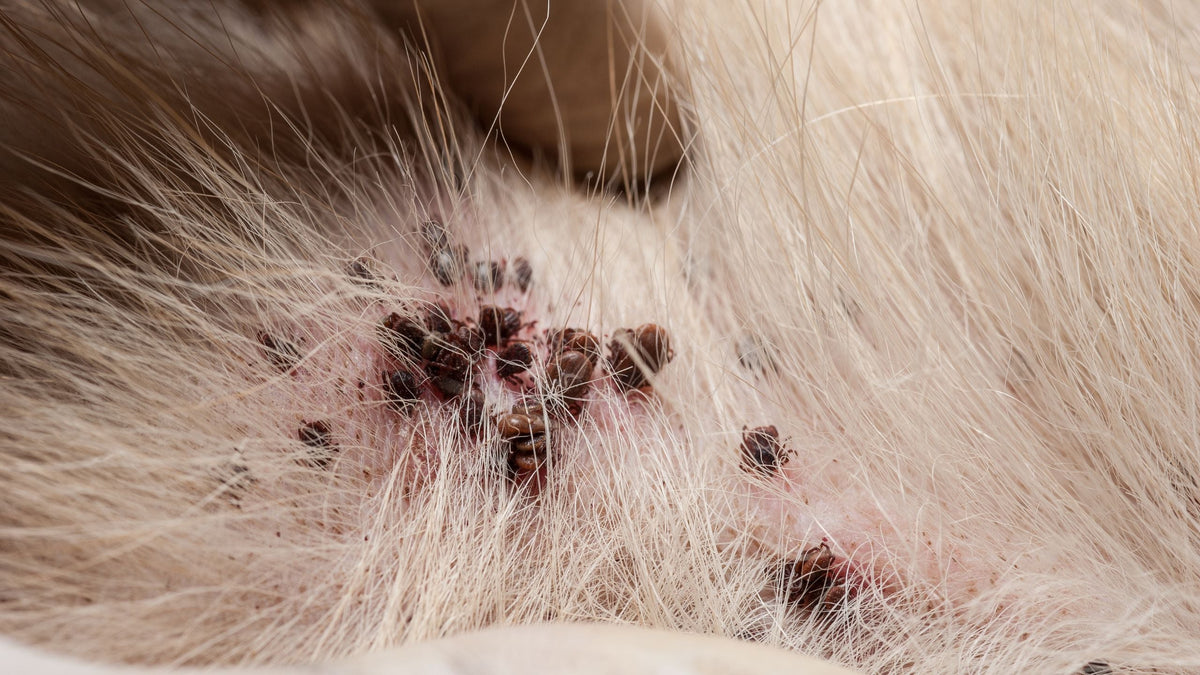
A newly attached tick feels like a tiny, firm lump on the skin – often only a few millimeters in size, even smaller in larvae. It sits on the skin, not in it. Fully engorged ticks are significantly larger, light gray to bluish, and feel soft and plump.
It is important to remember that not every raised area you can feel is a tick. From our practice, we know four common sources of confusion:
- Warts and papillomas: Common in older dogs, often skin-colored or slightly pigmented, firmly attached to the skin, with no body outside the skin.
- Fatty lumps (lipomas): Larger, softer, movable under the skin, and located deeper than ticks.
- Skin tags and granulomas: Sometimes the result of old tick bites; small, firm areas that can remain for years.
- Matted tufts of fur or plant material: These can be pulled off or combed out, unlike a tick anchored in the skin.
When we are unsure, we look under daylight or a bright lamp with our fingers spread. A tick has a visible body above the skin and usually recognizable legs. If in doubt, we call the veterinary practice instead of guessing.
Cooperative Care: why relaxed body handling is the foundation
The best palpation routine is of little use if the dog tenses up, turns away, or bites as soon as the paws or groin area are touched. Cooperative Care – meaning the dog’s active, voluntary participation in grooming and examination procedures – is therefore more than a nice-to-have in training. It is the prerequisite for daily control to work at all.
How we conditioned Vito and Amalia
We started early with both of them: short touch sequences, always with a calm voice, always voluntary, always with positive reinforcement. Paws, ears, belly, groin, tail – each area was built up individually. When the dog showed stress signals (turning away, licking, freezing), we took a step back instead of pushing through. That is the decisive difference from “the dog has to tolerate it.”
Today, Amalia lies on her back when she notices that we are starting the palpation. Vito stands sideways. Both have learned that this routine is part of everyday life – not an unpleasant special situation.
Our Vitomalia conclusion
Daily systematic palpation is the most effective mechanical prevention against tick-borne diseases that any dog owner can carry out – regardless of which antiparasitic product is used. Three points are crucial: first, routine – after every walk, not only when you suspect something. Second, a systematic approach – in the same order, focusing on the hot spots: ears, neck, armpits, groin, paws, base of the tail. Third, cooperative handling – a dog who participates calmly can be checked more thoroughly than one who turns away.
In our experience, daily palpation soon becomes as routine as wiping paws. Vito and Amalia know the process, we know their bodies, and we regularly find ticks at a stage where they have not yet caused transmission. You cannot achieve much more with a measure that costs nothing and has no side effects.