Halsband oder Geschirr ist keine Glaubensfrage. Wir erklären, wann welches Equipment sinnvoll ist und warum Passform, Alltag und Gesundheitszustand wichtiger sind als Lagerdenken.
Collar or Harness — few equipment topics are discussed as emotionally in everyday dog life. Camps form on social media. Collar users are sometimes criticised reflexively, while Harnesses are presented across the board as “automatically better.” We see it differently. Both types of equipment have their place. The honest question is not Collar or Harness, but: What quality, what fit, and what situation?
At Vitomalia, we are honestly among those who work almost exclusively with Collars in everyday life. Our AmStaff Vito and our APBT female Amalia wear wide, high-quality padded Collars in structured everyday life — and do extremely well with them. That is exactly why, in this article, we want to represent a position that is often missing from the public debate: A good Collar is not a problem. A poor Harness, however, very much can be. It depends on quality, training, and the individual dog.
Why the dramatization of Collars falls short
There is a trend that concerns us from a professional perspective: Collar users are often generally portrayed as acting against animal welfare. Anyone walking their dog on a Collar is looked at critically in some circles. That is not only unkind — it is also not factually sound.
What studies really show — and what they do not show
A frequently cited study by Pauli and colleagues from 2006 showed that intraocular pressure in dogs increases when they actively pull against a Collar. This is an important finding, especially for dogs prone to glaucoma or with existing eye disease. What the study does not show: that a well-fitting, wide Collar would be problematic for a dog with good loose leash walking in normal everyday life.
That is the point that often gets lost in the popular debate. The study is relevant for dogs that pull. It is not relevant for dogs that walk relaxed beside their person on a loose Leash. This exact distinction is missing in camp-based thinking.
Why quality decides almost everything
What Collar discussions very often ignore: not all Collars are the same. A thin, unpadded Collar can create localized pressure that is anatomically unfavorable during a Leash impulse. A wide, well-constructed Collar with raised, high-quality inner padding distributes pressure evenly, protects the neck from chafing, and still sits securely even after months of use.
We are manufacturers ourselves, and we build our Collars precisely for this reason: with a wide contact surface and inner padding that does not lie flat and bluntly against the neck, but is made to sit comfortably raised. This is not a marketing detail. It is the decisive difference between a Collar that concentrates pressure in one spot and a Collar that distributes the load over a larger surface. If you save money on a Collar, you buy anatomical problems — if you invest in quality, you get equipment that will accompany you reliably for years.
When a Collar is clearly our first choice
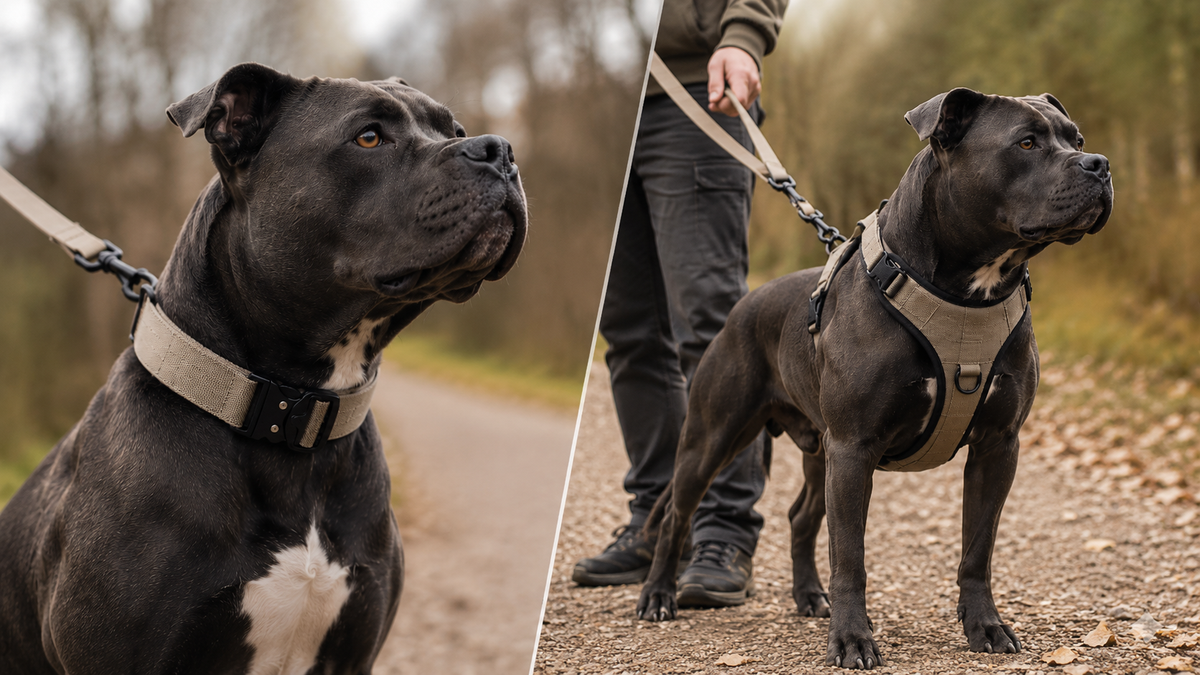
From our perspective, a well-made Collar makes sense whenever the dog has good loose leash walking, has no medical limitations in the neck or eye area, and does not belong to a brachycephalic breed with shortened airways. For exactly this situation — an adult, healthy, well-guided dog — a high-quality, wide Collar with anatomical padding is, in our practice, the uncomplicated and practical everyday solution.
What a Harness can do — and where it can still fail
Harnesses have advantages, and we do not question that at all. They distribute pulling force across a larger area of the body. They protect the neck area. In certain situations — more on that later — they are anatomically and honestly the better choice. But there are two important points that are systematically left out of the “a Harness is always better” narrative.
Point 1: A Harness can reinforce pulling behavior
This is probably the most frequently ignored observation from practical training. A Harness distributes pulling force in a way that is physically more comfortable for the dog. From a training perspective, however, this also means: the feedback to the dog is softer. Dogs that do not yet have loose leash walking often do not learn to pull less in a Harness, but more — because the physical resistance that could encourage them to release tension is reduced by the larger contact surface. This is not hocus-pocus, but a practical effect we see again and again in the Dog Training Academy and in everyday life. In many cases, a dog without loose leash walking tends to pull more in a Harness, not less.
So anyone who assumes a Harness will solve a Leash problem is mistaken. It can even cement it.
Point 2: Not all Harnesses are the same
The same applies to a Harness: the category says nothing; the cut says everything. Kinematic studies clearly show that restrictive Harnesses with a transverse strap over the shoulder joint measurably reduce the stride length of the forelimbs.
Classic Norwegian Harnesses are practical for everyday use, but anatomically critical because the chest strap often runs directly over the shoulder joint and restricts shoulder blade rotation. Well-cut Y-Harnesses leave the shoulder free and are usually biomechanically superior. But they, too, must fit precisely — belly strap behind the elbows, no pressure in the armpit, free shoulder blade rotation, clean Leash attachment point centered on the back. An inexpensive off-the-rack Y-Harness can be anatomically far worse than a high-quality Collar.
The ideal Vitomalia solution: have both, switch according to the situation
When someone asks us in a consultation what the best equipment strategy is, our answer is almost always the same: Have both. Collar and Harness — and decide according to the situation, the dog’s training level, and how the dog is doing that day.
When we use the Collar
For a classic, structured walk with a dog that has good loose leash walking, a wide, well-padded Collar is our equipment of choice. It provides fine feedback, sits reliably, does not restrict movement in any way, and suits calm, cooperative Leash work. For Vito and Amalia, this is the everyday norm.
When we switch to the Harness
There are situations in which the Harness is clearly the more anatomically honest choice. These include: young dogs that do not yet have loose leash walking and need safety in active training work. Dogs with known pre-existing conditions in the neck, trachea, thyroid, or eye area. Brachycephalic breeds with an already compromised upper respiratory tract. Reactive dogs where sudden lunges could create high localized forces. And finally, practical safety situations — for example securing the dog in the car, where a Harness is essential for crash-safety reasons.
Why the combination is often the most honest answer
A dog owner who has both — a high-quality Collar and a well-fitting Y-Harness — can make smart situational decisions. Structured walk in familiar surroundings: Collar. Training session with a young dog that still pulls: Harness. City environment with a high density of stimuli and an uncertain situation: Harness. Veterinary pre-existing condition: Harness. Car safety: Harness.
Anyone who understands this interplay has understood the equipment topic. It is not a matter of belief and not a dogma. It is a practical tool set that should be used appropriately.
What really matters: quality, fit, training
When we give honest advice to customers and clients, our order of criteria is always the same. First, the quality of the equipment itself. Second, the fit on the individual dog. Third, the training level. Anyone who thinks in this order will make significantly better decisions than someone who simply attaches themselves to the Collar or Harness camp.
Quality — how we recognize it
In a Collar, quality means: sufficient width so pressure is distributed rather than concentrated. Inner padding that does not lie flat and bluntly against the neck, but is raised and thus prevents friction and pressure points. Stable closures, high-quality materials, clean stitching. We made exactly this specification the standard at Vitomalia from the very beginning — not for aesthetics, but because it is the anatomical key to a relaxed wearing feel.
In a Harness, quality means: Y-cut with free shoulder blade rotation, belly strap at least four fingers behind the elbows, padded contact surfaces, clean central Leash attachment point on the back, ideally with an additional chest ring for more reactive dogs. Here, too: material, closures, and workmanship determine years of wear, not the first week.
Fit — the two-finger rule is not enough
For a Collar, the classic two-finger rule applies: there should be room for two fingers between Collar and neck, no more and no less. More important, however, is that the Collar lies flat and stable, does not rotate, and does not pinch fur. With a Harness, checking the fit is more demanding: Y-shape at the sternum, belly strap distance, freedom of movement in the shoulder, no pressure in the armpit, secure fit even with sudden movements.
Training — the equipment that nothing can replace
Whether Collar or Harness: equipment does not train. A dog that pulls does not learn loose leash walking through the Collar, and does not learn it through the Harness either. Loose leash walking is training. Equipment is only the tool used to implement this training fairly and safely. Anyone who does not separate these things will be dissatisfied with any equipment.
Our Vitomalia conclusion
We are among those who expressly do not demonize a good Collar. On the contrary: for a healthy dog with good loose leash walking, a wide Collar with anatomically considered padding is, in our experience, the most uncomplicated and honest everyday choice. Vito and Amalia wear exactly these kinds of Collars — and do extremely well with them.
But we are also among those who recommend Harnesses where they truly make sense. Young dogs in training, brachycephalic breeds, dogs with neck or eye problems, reactive dogs with safety requirements, car safety — here, the Harness is the more anatomically honest choice, and we say so clearly.
The most honest recommendation for most dog owners is therefore: Have both. A high-quality, wide-constructed Collar with raised inner padding as everyday equipment, and a well-cut Y-Harness for situations where it makes more sense anatomically or from a safety perspective. Anyone who has both and switches wisely according to the situation has solved the equipment question.
What remains important: do not save money on quality. A cheap Collar is not the same as a high-quality one. An inexpensive off-the-rack Y-Harness is not the same as one with an anatomically considered cut. Anyone who invests in good equipment buys years of comfort that neither dog nor dog owner will want to be without. And it is exactly along these lines that we build every single Collar at Vitomalia — not as mass-produced goods, but as a premium product for people who value substance.