Berührung kann für einen Hund eine echte Belohnung sein — aber nur dann, wenn der Hund diese Form von Kontakt wirklich mag. Wir zeigen, wann Streicheln im Training sinnvoll ist, wann es Stress macht und warum gute Hundeerziehung auch hier mit genauer Beobachtung beginnt.
Touch as a reward sounds like one of the simplest methods of all: stroke, scratch, praise — done. But it is not that simple. Touch can genuinely be reinforcing for a dog, but it can just as easily trigger stress or simply mean nothing at all. What is a real reward for a dog depends on the individual, the situation, and the type of touch.
In this article, we look at when touch makes sense as a reward, when it becomes counterproductive, and how we can use it correctly in everyday life with our dogs. We draw on current behavioral research — and on what we see every day in our training and behavioral therapy practice. Because here, too, what is presented as self-evident does not always stand up to scientific scrutiny.
What touch means to a dog
Dogs are tactile animals. Through their skin, they gather information, communicate with other dogs, and regulate themselves emotionally. Touch is therefore never neutral — it is always a signal. The key question is simply: Which signal does the dog receive?
body language and communication in dogs
Touch is part of the canine communication system. Puppies are licked, groomed, and kept in a warm group by their mother — from the very beginning, physical contact is linked to safety and care. Among adult dogs, too, there are subtle tactile signals: carefully leaning against each other, lying together, mutual gentle nibbling between familiar partners.
When we, as humans, touch a dog, we enter this communication system — whether we intend to or not. A hand on the back is not a neutral gesture for the dog, but a statement. Depending on how this gesture is performed and in what context, it can feel calming, inviting, intrusive, or threatening. In our consultations, we repeatedly see dog owners surprised by how much information is contained in hand posture alone: an open hand at chest height feels different from an outstretched hand coming from above over the head.
Actively sought vs. offered contact
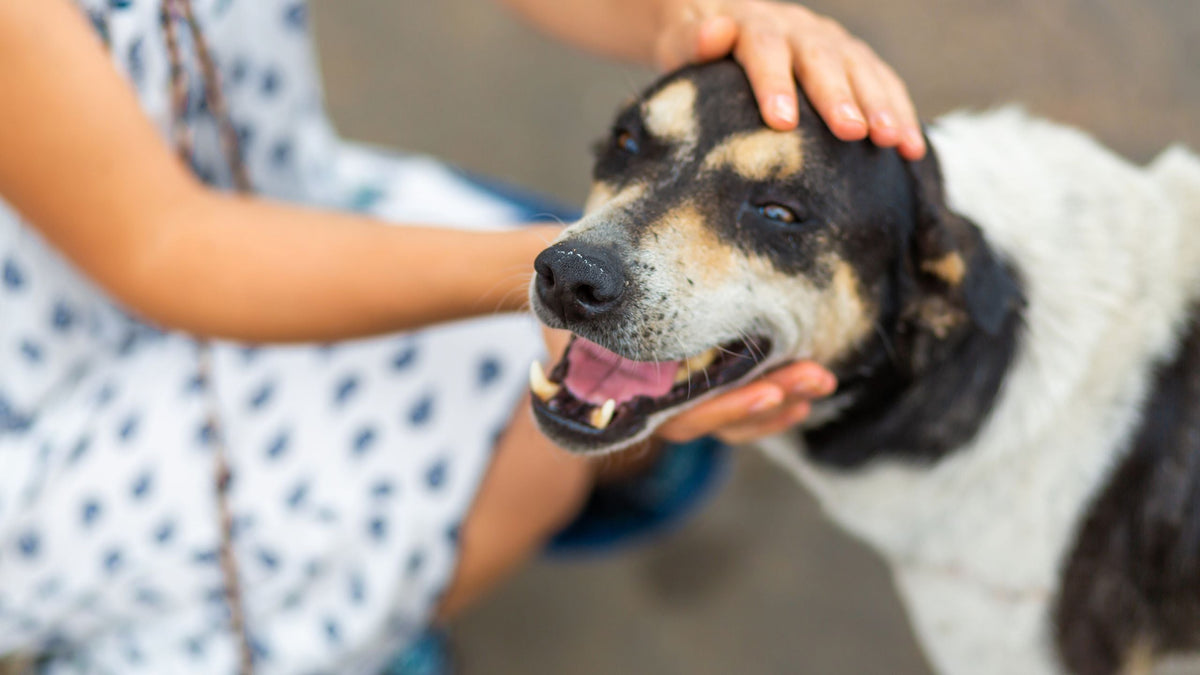
It is important to distinguish between touch that the dog actively seeks and touch that we actively offer. When a dog initiates contact on its own — leaning against you, placing its head on your knee, nudging its head under your hand — it is signaling readiness. In these moments, stroking can genuinely have a calming effect because the dog has control over the interaction.
By contrast, if we stroke a dog over the top of the head without the dog having shown any initiative, from the dog’s perspective this is a very direct gesture and often feels intrusive. Many dogs tolerate it because they have learned to — but they do not enjoy it. Anyone who pays attention to the subtle signals (briefly turning the head away, lip-licking, looking away) will see this confirmed in everyday life as well. In several observational studies, Kuhne and colleagues showed that dogs typically respond to imposed touch with subtle stress signals long before visible defensive behaviour appears.
When touch is truly a reward
For touch to work as a reward, three conditions must be met: the dog likes this type of touch, the touch happens at the right moment, and the dog is in a state in which they can actually take in touch.
Positive associations and trust
Touch has a reinforcing effect when it is linked to positive experiences. If a dog has been handled with a calm, kind hand since puppyhood, treated patiently during grooming, and not forced into touch, a fundamentally positive association develops. Later, this dog will perceive petting as a reward — because hands are associated with safety for them. This is exactly where the principles of Cooperative Care come in: the dog has a genuine choice about when touch begins and when it ends. This choice creates trust, and trust is the very foundation that allows touch to function as a reward in the first place.
If, on the other hand, a dog is often handled roughly, held tightly, clipped without preparation, or groomed under pressure, touch becomes ambivalent. Such dogs may tolerate stroking without it being reinforcing for them. In training, touch would then fall flat — it is neither a reward nor a punishment, but simply not a stimulus the dog responds to. In our behavior work, this is one of the most common points where we start again with dog owners: before we can use touch as a reinforcer in training, it first has to mean to the dog again that something good is happening.
Individual differences in dogs
Not every dog likes being stroked to the same degree. This is one of the most important insights we repeatedly need to share in our work with clients. Some dogs love long neck scratches, while others only tolerate them briefly. Some enjoy a back massage, while others find touch on the belly intrusive. There are dogs who actively seek physical contact, and dogs who prefer a calm, safe distance.
We see the difference every day with our own dogs. Vito, our AmStaff, is a classic contact seeker: he leans in, likes to rest his head on a thigh, and enjoys having his chest and shoulders scratched at length. Amalia, our APBT, who came to us at six months old, is more selective. She actively seeks closeness — but she decides very clearly when she has had enough. She does not like quick patting at all, but she very much enjoys calm stroking movements on her shoulders. The same family, two dogs, two completely different touch profiles. That is exactly the point: what touch means to an individual dog cannot be derived from breed or size — you have to observe the specific dog in front of you.
These differences depend on temperament, learning history, current mood, and previous experiences. Dogs with an uncertain background often need more time before touch truly feels pleasant. Other dogs are simply more physically reserved and want to decide for themselves when closeness feels right. Respecting exactly that is part of a good relationship, not a training mistake.
When touch is counterproductive
There are clearly defined situations in which touch — even when well-intentioned — does not help, but causes harm. Recognizing this is part of responsible dog training.
In stressful situations
A common everyday scenario: the dog barks excitedly at the fence, or trembles at the veterinarian’s office. The person responds intuitively with stroking and soothing words. What is understandable from a human perspective can have the opposite effect on the dog.
If a dog is in a state of high arousal, their system is already overstimulated. Additional stimuli — even positive ones — can increase this arousal further instead of reducing it. In such moments, the best thing we can often do is stay calm, give the dog space, and not put additional pressure on them. Touch can come later, once the system has settled.
The exception is dogs that can be measurably down-regulated through calm, slow physical contact — for example, sitting together with a hand placed at the side of the chest, without hurried stroking. But this only works if the relationship is stable and the dog actively accepts this type of contact. It is an individual matter, not a general rule.
In cases of pain or discomfort
A dog in physical pain responds to touch differently than a healthy dog. Pain is one of the most common and most underestimated causes of changes in behavior. What looks like a sudden refusal to be stroked or irritability is quite often a medical signal.
If a dog that previously liked being touched suddenly resists contact on certain parts of the body — the back, the hips, the ears — that does not belong in training, but at the veterinarian’s office. In our work, we repeatedly see cases where dog owners spend months dealing with supposed training problems, until it turns out that there is a physical cause behind them. A dog that flinches when touched, suddenly twists away, or resists approach is telling us something — and our job is to listen.
During high activity or exhaustion
Touch as a reward in training has its place — but not in every phase. In highly active, fast-paced training sessions, stroking is usually too slow and too calming. Here, food, play, or a short, clear verbal cue is usually the more precise choice.
Petting is just as unhelpful when the dog is exhausted. A dog after a long hike, after intense interaction with other dogs, or after an overstimulating visit to the city needs rest — not additional stimuli, not even gentle ones. We see this with Amalia too: when she is truly tired, she withdraws to her place and does not want a hand in that moment. This is not a relationship problem, but self-regulation, which we respect.
Touch is better suited to transitions: after a good exercise, at the end of a training session, or in calm moments of bonding work. This way, we use the natural function of touch — maintaining relationship — rather than misusing it as a quick reward.
How we use touch in training and everyday life
All of this gives us a clear picture of how touch can be used meaningfully in everyday training. It is less about technique and more about attitude.
Ask the dog before we touch
A simple routine we recommend: We offer the dog our hand — open, calm, within their reach — and observe what they do. Do they come forward actively, nudge with their nose, lean in? Then contact is welcome. Do they turn their head away, move back, lick their lips? Then not.
In training literature, this approach is often described as the Consent Test or the Five Second Rule: We pet for about five seconds, then pause and take our hand away. If the dog continues to seek contact, the touch was welcome — and we continue. If they turn away, shake off, or walk away, it was enough. This short pause takes less than two seconds and changes the entire dynamic of an encounter. The dog learns: hands are not something that simply happens — hands come when I want them. This is exactly what builds trust and makes touch, in the moments when it happens, a genuinely positive stimulus.
The right place, the right movement
When we pet a dog, we choose areas that many dogs experience as pleasant: the chest, the sides of the neck, behind the ears, or the flanks. As long as we do not know the dog very well, we should avoid the top of the head, the paws, the tail, and the belly. These areas are communicatively sensitive, and many dogs only enjoy touch there when there is particular trust.
The movement itself should be calm, slow, and in the direction the coat grows. Fast patting, hectic rubbing, or firm pressure are not relaxing stimuli from a dog’s perspective — they are more likely to be play signals or pressure. Hugs, too, as human and affectionate as they may feel, are a very direct restriction of freedom of movement from a dog’s perspective. Most dogs tolerate them, but they do not enjoy them. If you truly want to reward a dog, you pet them differently than you would greet a person.
Getting puppies used to touch early, but voluntarily
With puppies, targeted, positive preparation is worth it. Touching paws, holding ears gently in your hand, briefly touching different parts of the body — all in small doses, combined with a calm voice and good food. If you build this early, you will later have a dog who calmly takes part in veterinary examinations, nail care, and coat care. This is not only a matter of everyday veterinary practice — it is a matter of quality of life. Important: build it freely, do not force it. If you hold a puppy down and examine their paws against their will, you are not building a positive association; you are teaching avoidance.
With Amalia, we had to make up for this because she came to us at six months old and had not experienced some of it. It worked — but more slowly, with more patience and smaller steps than with a ten-week-old puppy. That, too, is an important message: missed experiences can be made up for, but it takes time.
Touch as one tool among several
We never use touch in training as the only reward. It is one tool among several — alongside food, play, voice, space, and the simple presence of a reliable human. Depending on what the dog needs and what the situation requires, we choose the appropriate tool.
For most dogs we work with, food is the fastest and most precise reward in training development — this aligns with comparative studies in which dogs clearly preferred food over being stroked. Touch is added as a bonding tool — at the end of a session, in calm moments, and in everyday life. This distinction is what separates mechanical training from a genuine relationship with the dog.
Our Vitomalia conclusion
Touch as a reward is not automatic. It works when we take the individual dog in front of us seriously — their preferences, their learning history, their current state. It does not work as a blanket “a little bit of petting will do.” Vito and Amalia show us this every day: two dogs in the same household, the same trusted person, completely different touch profiles. Anyone who applies blanket rules to all dogs misses exactly the point that matters.
What we as trainers and dog owners can develop is a basic attitude: we do not touch the dog because we feel like it, but when the dog feels like it. This small reversal fundamentally changes how we interact. It leads to dogs who read human hands as a positive signal, and to people who truly see their dog instead of simply handling them.
In training itself, we treat touch for what it is: a valuable but specific tool. For a quick, precise moment of reinforcement, food is usually superior. For the long-term relationship, for calm transitions, and for bonding work, touch is indispensable. When you use both with care and differentiation, you have a broad set of tools — and a dog who can clearly understand different forms of reward. For us, that is exactly the foundation of a relationship that lasts: knowledge grounded in research, combined with an honest view of the individual dog right in front of us.