Ein sogenannter Entspannungs-Griff kann nur dann beruhigend wirken, wenn der Hund ihn positiv gelernt hat. Wir erklären, wann Körperkontakt reguliert und wann aus vermeintlicher Hilfe nur Fixation wird.
![Calming an agitated dog: Relaxation grip [Part 6]](https://i.ytimg.com/vi/kZ-IiBIZ5Qs/hq720.jpg)
Your dog is aroused – the heart is racing, the eyes are flickering, the body is tense. In exactly this moment, many people think of a term that keeps circulating online: the “relaxation hold”. A hand on the chest, a light touch on the neck, and the dog is supposed to calm down. Sounds simple. But it is not.
We – Lui as a canine behavior therapist and Paulina as a canine scientist – want to clear up a persistent misunderstanding in this article: A relaxation hold is not a reset button. It is a trained, positive routine. And whether it works does not depend on the technique, but on how your dog has learned the touch. Vito and Amalia, our two restricted breed dogs, show us this every day – in very different ways.
What a “relaxation hold” really is – and what it is not
The term sounds like magic, but in truth it is learning psychology. A relaxation hold is a conditioned touch: a specific hand or body position that your dog has linked with safety, calm, and positive experiences. Only through this association does the touch itself become a signal – the nervous system shifts down a gear because it has learned: “When this hand is placed like this, everything is okay.”
The research behind it: touch has an effect – but not just any touch
A widely cited study by Handlin and colleagues (2014, Anthrozoös) showed that calm, friendly touch between humans and dogs releases oxytocin in both parties – the hormone that supports bond and relaxation. Another paper by Coppola and colleagues (2006, Physiology & Behavior) demonstrated that calm human contact can lower cortisol levels in dogs in stressful situations. The emphasis here is on calm and familiar. Both studies worked with dogs who experienced touch positively, not with panicked or unfamiliar animals.
This is the crucial point: The effect does not come from the hold itself. It comes from the relationship and the learning that happened beforehand. If someone simply places a hand on an aroused female dog’s chest without her ever having experienced that gesture in a relaxed context, they are restraining her – and restraint is stress, not relaxation.
Why imposed holds often have the opposite effect
In practice, we see this all the time: dog owners who want to “calm” their dog in a moment of arousal by holding them still. The dog freezes, stops panting, appears calm. In reality, the dog is not relaxed – they are in a state of shock immobility. In behavioral biology, this is called “tonic immobility” or simply freezing. It looks like calm, but it is the exact opposite.
The risk of flooding
In behavioral therapy, “flooding” – unavoidable confrontation with a stimulus – has been documented as problematic for decades. Holding a panicked dog and waiting for relaxation can, in the worst case, be exactly that. The result is not learned coping strategies, but learned helplessness. We see this especially often in reactive dogs whose dog owners mean well, but do not give their dog’s nervous system a real chance to regulate.
What Linda Tellington-Jones taught us
Linda Tellington-Jones’ TTouch method is one of the best-known body-oriented approaches to working with dogs. It is based on slow, circular touches and what are known as “body wraps”. Scientifically, TTouch is not as extensively supported as is often claimed – controlled studies are rare. What can be derived from the underlying principle, and what aligns with current research on touch, is this: light pressure, slow movements, and predictability can activate the parasympathetic nervous system. Exactly what we want to support in an aroused dog.
The decisive point with Tellington-Jones was always: The dog is allowed to leave at any time. This attitude – now discussed under the term Cooperative Care – is what separates a learned relaxation hold from a coercive measure.
How we build a relaxation hold
A functional relaxation hold is not created in stress, but in calm. We train it like any other signal: in small steps, with a high rate of reinforcement, and always with the option for the dog to say “no”.
The four building blocks
1. Allow choice. We sit down calmly and wait to see whether the dog seeks contact on their own. If they come, the exercise begins. If they do not, the answer today is “no” – and that is respected. This principle comes from Cooperative Care work and is now standard in modern behavioral therapy.
2. Start with the lowest stimulus. A flat hand, placed loosely on the shoulder or on the side of the ribcage. Not on top of the head, not on the neck, not from the front. Duration: one second. Immediately afterwards, a high-value piece of food. Repetition: many short sessions, not one long one.
3. Increase duration and intensity slowly. Only when the dog actively enjoys the brief touch – leans in, the eyes soften, the body stays loose – do we increase to two or three seconds. Weeks, not days.
4. Test in neutral situations. The hold is only used in mildly exciting situations once it is an absolutely reliable relaxation signal in calm conditions. Never first in acute stress.
Vito and Amalia: two dogs, two routines
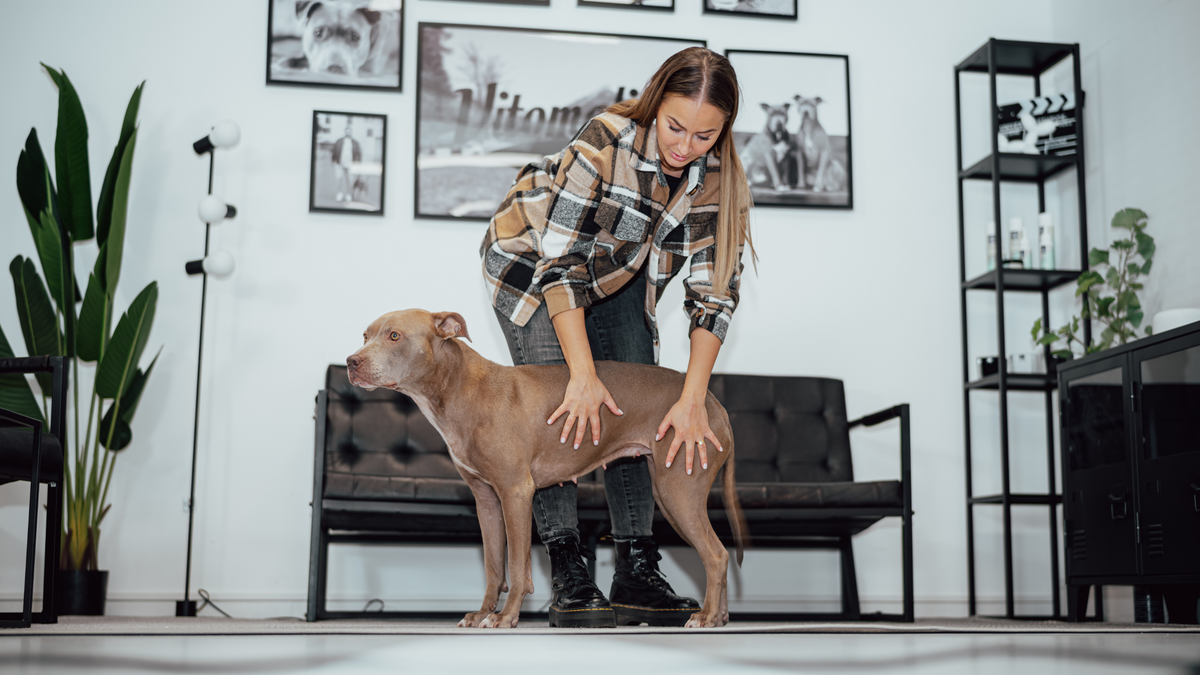
For us, this looks very different in practice. Vito is the dog who seeks physical closeness on his own. His relaxation signal is a flat hand on his chest while he leans against our leg. He practically taught himself this position – we simply reinforced it consistently.
Amalia, on the other hand, is more reserved with touch, especially when she is aroused. Her relaxation signal is therefore not a hand on her body, but sitting calmly next to us while we place only one hand on the floor beside her. She decides whether she seeks contact. If we used Vito’s routine with her, it would not be a relaxation hold for her – it would be pressure.
This is the point we most often need to explain to dog owners: There is no single “right” hold. There is only the one your dog has learned individually and evaluates positively.
When a relaxation hold is not the right tool
We are generally careful about presenting physical interventions as a universal solution. In the following situations, a relaxation hold is not appropriate:
- In acute panic. A dog who is in a panic attack often cannot access a trained touch in that moment. Here, we need distance from the trigger, not an additional stimulus.
- In pain. Touching a dog who has orthopedic or other pain can increase stress. Reactivity is surprisingly often a pain issue – a veterinary check belongs before any training plan.
- When trust is lacking. Dogs who have only just moved in or who have a difficult history with people need weeks or months of relationship work before touch can be built as a relaxation signal.
- For dogs who do not actively appreciate touch. Some dogs are simply less oriented toward physical contact in their personality. That is okay. Other calming routines work better for them – search games, chewing, a calm voice from a distance.
Our Vitomalia conclusion
A relaxation hold is not a trick, but a relationship in the form of touch. It works when it has been positively conditioned in calm situations, when the dog is allowed to say “no” at any time, and when we use it where the nervous system is still able to process a learned signal. Imposed, in stress, without preparation, a hold quickly becomes restraint – and restraint does not relax any dog.
We would like to see more dog owners stop trying to fix their dogs and instead understand what is happening in their bodies. When your dog is aroused, it is rarely a training problem – it is a nervous system that is actively working. Our task is not to push it down. Our task is to offer tools the dog can use independently. A learned relaxation hold can be one of those tools. But only then.