Wenn ein Hund aggressiv reagiert, wird die Schuldfrage meist sofort aufgemacht. Wir erklären, warum Verantwortung wichtig ist, Schuldzuweisungen aber häufig verhindern, dass Ursachen sauber erkannt und behandelt werden.
When a dog reacts aggressively, it usually does not take long before the first question is asked: Who is to blame? The dog owner, because they made mistakes? The dog, because they are “just like that”? The breed? The training? Genetics? This question seems logical, almost inevitable. But as uncomfortable as it may sound, in most cases it is the wrong question. It blocks what the dog and dog owner actually need: calm, objective analysis.
In our daily work, we support dog owners who come to us with a clear feeling: I must have failed. Sometimes they sit almost collapsed in the initial consultation because, for weeks or months, the people around them have signaled that their dog’s behavior is their personal failure. Dog owners of restricted breed dogs, powerful dogs, or dogs burdened by social stigma know this pressure especially well. And almost always, our work begins by taking that pressure out of the situation — not out of pity, but because no one can think clearly under the weight of guilt. And without clear thinking, there can be no good behavioral analysis.
Why the question of blame is so appealing — and so unhelpful
Blame creates quick order. When a behavior is frightening, people reflexively look for someone or something to blame. Psychologically, that is understandable. A clear attribution of blame calms the need for control: if someone is at fault, then we know the cause, and the world becomes predictable again. This applies to bystanders at the dog park just as much as to media coverage of bite incidents.
From a behavioral medicine perspective, however, this logic is hardly sound. Aggressive behavior does not, in reality, arise from a single moral cause. It is functional behavior fed by several layers at the same time: physical condition, genetic disposition, early rearing, learning history, current environment, stress load, relationship with the dog owner. If you cut out one of these layers and declare it the main culprit, you reduce reality so much that meaningful work is hardly possible anymore.
Blame blocks analysis
As soon as behavior is read morally, the questions shift. Instead of examining which triggers, pain, fears, or excessive demands may be involved, the discussion turns to who made mistakes. But blame does not create a good training plan. Blame usually creates defensiveness, justification, withdrawal — or, in the worst case, a dog owner who hides problems because they feel ashamed.
Especially in acute situations, we need the opposite: calm, safety management, medical clarification, an honest trigger analysis, and a realistic picture of what is putting this dog under strain in that moment. Blame creates heat. Good casework needs a cool head.
What research really says about blame
The scientific literature on aggression in pet dogs has developed considerably over the past ten years. What is striking is how consistently it has moved away from simple attributions of blame. Today, aggression is not understood as a character trait, but as context-dependent behavior with medical, emotional, and social components.
This dependence on context is crucial for our topic. If aggressive behavior is linked to specific situations — certain triggers, certain spaces, certain encounters — then it cannot plausibly be attributed to a single, global factor of blame. The question is never “Who is to blame?” but “What exactly is happening in this situation?”
Fear as an underestimated main cause
One area where the logic of blame regularly fails is fear. Reactive behavior on the Leash, defensive snapping, defensive barking — much of what is categorized in everyday life as aggression is, at its core, fear-based. Dog owners are often morally judged for this behavior, even though the dog is simply trying to protect itself.
This figure is so relevant because it shows that in a substantial proportion of cases, the behavior is not an expression of poor training, but of a stressed nervous system. The right response to this is not harshness, but safety, distance management, and a calm learning history. Blame does not help here at all.
The levels that are almost always overlooked
When we work through cases with dog owners, we never look at the person first. We look at the levels that are most often overlooked in public discourse. In our experience, four of them are particularly underestimated.
Pain and medicine
Pain is perhaps the most underestimated topic in behavior work. A dog that suddenly snaps, resists touch, or responds aggressively during certain movements may have a medical problem — and not necessarily a training problem.
In practical terms, this means: with any form of sudden-onset or difficult-to-explain aggression, a thorough veterinary assessment should come first — orthopedics, neurology, internal medicine, teeth, ears, skin. Only after that is it possible to speak about behavior in a serious way. Anyone who begins here by assigning blame to the dog owner is putting the cart before the horse.
Genetics and breed — much smaller than assumed
On the other side of the blame debate is the idea that the dog was simply “bred that way.” This, too, is an oversimplification that is not supported by the current research. Genetics influence behavior, but they do not determine it.
Polygenic reviews from recent years confirm this picture: aggression behavior is not linked to individual genes or breeds, but is inherited polygenically and strongly modulated by the environment. This does not mean that genetics is irrelevant, nor that every dog can learn everything. It means: the individual before the breed, context before labels.
Early rearing and socialization
One factor that almost never comes up in debates about blame, but is immensely important from a behavioral biology perspective: the first weeks of life. Puppies that grow up in low-stimulus, stressful, or socially deprived environments develop a different neural foundation than dogs from stable, well-stimulated rearing conditions.
Our Amalia came to us at six months old. Six months during which we were not there, during which we do not know exactly what she experienced. We carry this part of her biography with us. It does not mean that every dog with an unknown history will inevitably become conspicuous. But it does mean that we realistically factor in what we could not influence. This humility is entirely missing from many debates about blame.
Learning history and current environment
The fourth point that is often overlooked is the dog’s learning history in their current life. Dogs are learning constantly — even when no one is consciously training. Every encounter that goes wrong, every escalation, every overwhelming situation leaves a trace. A city full of close encounters, an apartment building with constant stimuli, a hectic daily routine with too little recovery — all of this is part of the equation.
Dog owners do have influence over this environmental level, but not total control. Anyone living in a big city can manage the level of stimuli, not eliminate it. Anyone who works cannot filter triggers every second. Constructing blame from this ignores the lived reality of people with dogs.
Responsibility instead of blame — the key difference
This is where a misunderstanding often arises. Anyone who criticizes blame-based thinking can seem to be releasing dog owners from responsibility. That is exactly not what is meant. Responsibility remains central. But it looks in a different direction than blame.
Blame looks backward: Who did something wrong? Responsibility looks forward: What needs to be done now? These two perspectives lead to completely different actions. Blame-oriented dog owners justify themselves, avoid help, and conceal incidents. Responsibility-oriented dog owners analyze, seek support, organize management, and accept limits.
What dog owner responsibility means in concrete terms
Anyone who keeps a dog carries responsibility for safety management, veterinary assessment, appropriate training, a realistic appraisal of their own capacities, and the protection of others. This is not negotiable. If a dog reacts dangerously, decisions have to be made: muzzle training, distance management, professional support, and, in severe cases, honest questions about whether the situation can be sustained.
This responsibility is demanding. But it is achievable — especially when it is not overshadowed by shame. Dog owners who know they are allowed to seek help without immediately being morally taken apart look for support earlier. That is what increases safety, not public outrage.
When even perfect dog owners still cannot “train it away”
Some dogs enter life with real genetic, medical, or early developmental burdens. Even excellent dog owners with professional support cannot achieve every desired outcome with these animals. That is an uncomfortable but important truth. Behavior work can reduce burdens, increase safety, and improve quality of life — it cannot erase every predisposition.
This admission is not failure. It is realism. And it is the basis for honest decisions — about management, about living conditions, and in rare cases, about firm boundaries. A blame-based mindset makes such decisions impossible because it turns every step into an accusation.
Why restricted breed dog owners are particularly affected
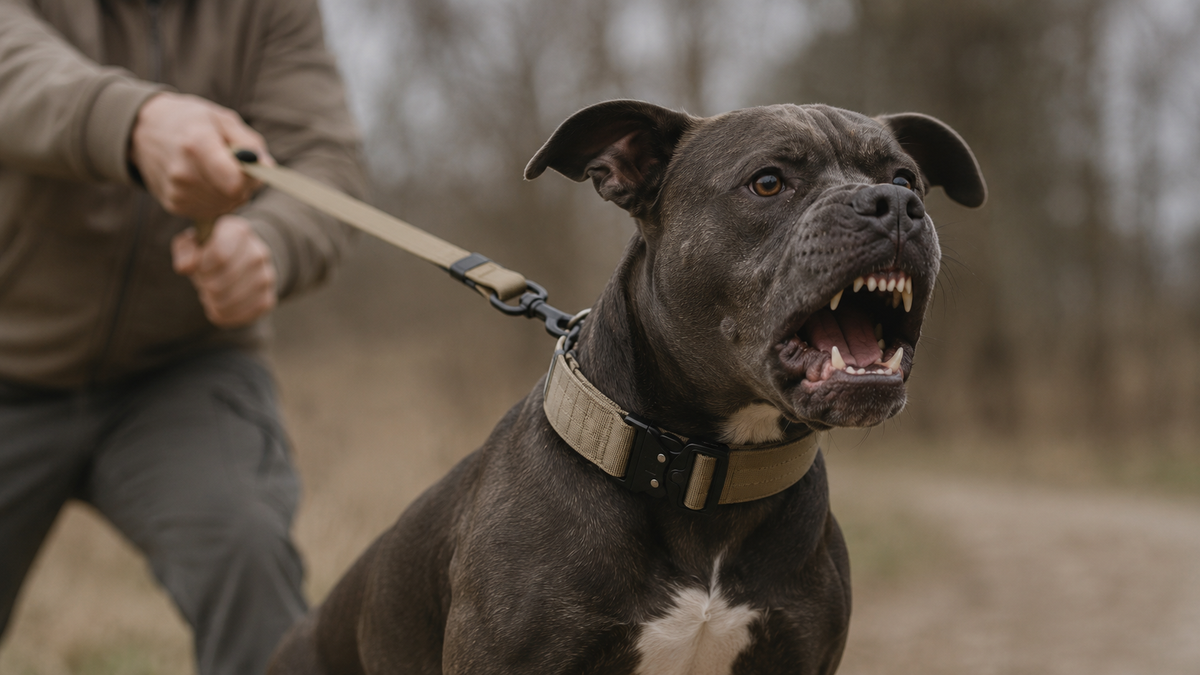
We work a great deal with dog owners of so-called restricted breed dogs. For these owners, the question of blame is not just background noise, but a constant companion. An American Staffordshire Terrier that barks on the Leash is judged differently in the public eye than a Labrador doing the same thing. The same reaction is assessed differently on moral grounds — depending on the dog’s phenotype.
This has real consequences. Dog owners withdraw, avoid encounters, train defensively, and avoid public visibility. What may look like responsible behavior is often protection from social judgment. The problem is this: anyone who trains out of shame does not train calmly. And anyone who does not train calmly transfers tension to the dog. Stigmatization produces exactly the symptoms it claims to prevent.
Our Vito and our Amalia are both powerful dogs with a distinctive appearance. We know the sideways glances, the exaggerated detours on the sidewalk, the comments. We have learned to withstand them without letting them seep into our training decisions. But we also know that not every dog owner develops the same routine. That is exactly why part of our work is to strengthen dog owners’ confidence — with professional clarity, not emotional idealization.
What truly helps — instead of looking for blame
If the question of blame does not move us forward, what does? In our experience, there are six points that make the difference in almost every case — regardless of breed, background, or severity of the behavior.
First: start with a medical assessment. Pain and physical causes must be ruled out or treated before behavior-focused work begins. Second: solid safety management. Muzzle training, Leash handling, distance control — this is not a punishment for the dog, but protection for everyone involved. Third: trigger analysis instead of debating symptoms. We are not interested in the question “Is the dog aggressive?”, but in “In what situation, with which trigger, with what prior history, and at what arousal level?”.
Fourth: honest self-assessment by the dog owner. What resources, what knowledge, and what personal limits are present? This is not a question of blame, but a question of reality. Fifth: professional support. Behavior work with aggression is not something to take on alone. Sixth: realistic expectations. Not every behavior can be fully resolved — some things can be managed, and that is a legitimate goal.
Our Vitomalia conclusion
The question of blame is the wrong question. It appears to bring clarity, but in most cases it obscures the issue. Aggression arises from an interplay of genetics, early upbringing, medical condition, learning history, current environment, and dog owner guidance. Anyone who cuts out one of these levels and declares it the main culprit simplifies reality so much that good work is barely possible.
At Vitomalia, we stand for factual, blame-free behavior analysis. Not because responsibility does not matter to us — quite the opposite. But because we know that responsibility is carried best where it is not constantly under moral pressure. Dog owners who do not have to justify themselves think more clearly. Dogs whose owners think clearly benefit from that. And public safety improves when help becomes easy to access rather than stigmatized.
If you recognized yourself while reading — as a dog owner who has been out and about for months or years with a dog showing concerning behavior and who constantly feels under pressure to prove themselves — we want to leave you with one thought: responsibility faces forward. Blame faces backward. Do not let yourself be paralyzed by the wrong direction. Look closely, get support, and work with the dog you have — not with the dog others expect you to have. For us, that is exactly where genuine responsibility as a dog owner begins.