Aggression ist kein Charakterfehler und fast nie ein einzelnes Erziehungsproblem. Wir ordnen ein, welche Motive hinter aggressivem Verhalten stehen und warum Schmerz, Angst und Überforderung immer mitgedacht werden müssen.
When a dog shows aggressive behavior, the situation quickly becomes morally charged. The dog is seen as difficult, the dog owner as overwhelmed or negligent. That is hardly helpful for a professional assessment. Aggression is not a character flaw to begin with, but behavior with a function.
As a canine behavior therapist and a canine scientist, we see every day how much pressure weighs on people whose dog growls, snaps, or lunges forward. That is precisely why, with aggression, we do not look first at blame, but at motivation. A dog may want to create distance, protect pain, react out of fear, defend resources, or be under chronic overwhelm. Only when we understand this function does behavior become truly trainable — and the dog shifts from being the “problem” to a case that can be worked with.
What aggression means from a behavioral biology perspective
Aggression is not a fixed label that “sticks” to a dog. It is a behavioral repertoire that becomes more likely in certain contexts. This repertoire is influenced by learning history, arousal, health status, environmental conditions, and social experience. That is exactly why the statement “my dog is aggressive” is often too broad to be practically helpful. It describes a symptom, not a cause.
From a behavioral biology perspective, aggression is first of all a way to influence a situation. It can create distance, secure access, ward off a threat, or release an internal stress level. That does not make it harmless. But it shows why purely moral judgments in training usually miss the point. Behavior that serves a function does not disappear because someone gets angry — it disappears when the function can be fulfilled in another way or the triggering state changes.
Why the question of function matters more than the label
When we only name a behavior, we still do not know how to respond to it. Growling at the food bowl, lunging forward on the Leash, and a quick snap while being dried off may all look like aggression from the outside. The training logic is still not the same. One may be resource guarding, another frustration or fear, the third pain. Three times the word aggression — and three completely different training plans.
This is exactly why skilled trainers and veterinary behaviorists do not work with premature labels, but with contextual analysis. What happens beforehand? What ends the behavior? Which triggers keep recurring? How high is the arousal level? What role do distance, confinement, touch, or social insecurity play? Only these questions turn a problem into a workable picture. Karen Overall, one of the most influential veterinary behaviorists of our time, describes this precisely in her Manual of Clinical Behavioral Medicine for Dogs and Cats: diagnostically, aggression can only be understood through context, topography, and function — not through gut feeling.
Common motivations behind aggressive behavior
In everyday life, we repeatedly see similar motivations behind aggression. What matters is not forcing every case into a rigid category. Many dogs show mixed motivations — a fear-based dog may also develop frustration on the Leash, and a dog in pain may additionally defend resources. Even so, functional classification is extremely helpful because it makes training and management clearer and helps dog owners move away from the feeling that they have a “bad dog.”
Fear and insecurity
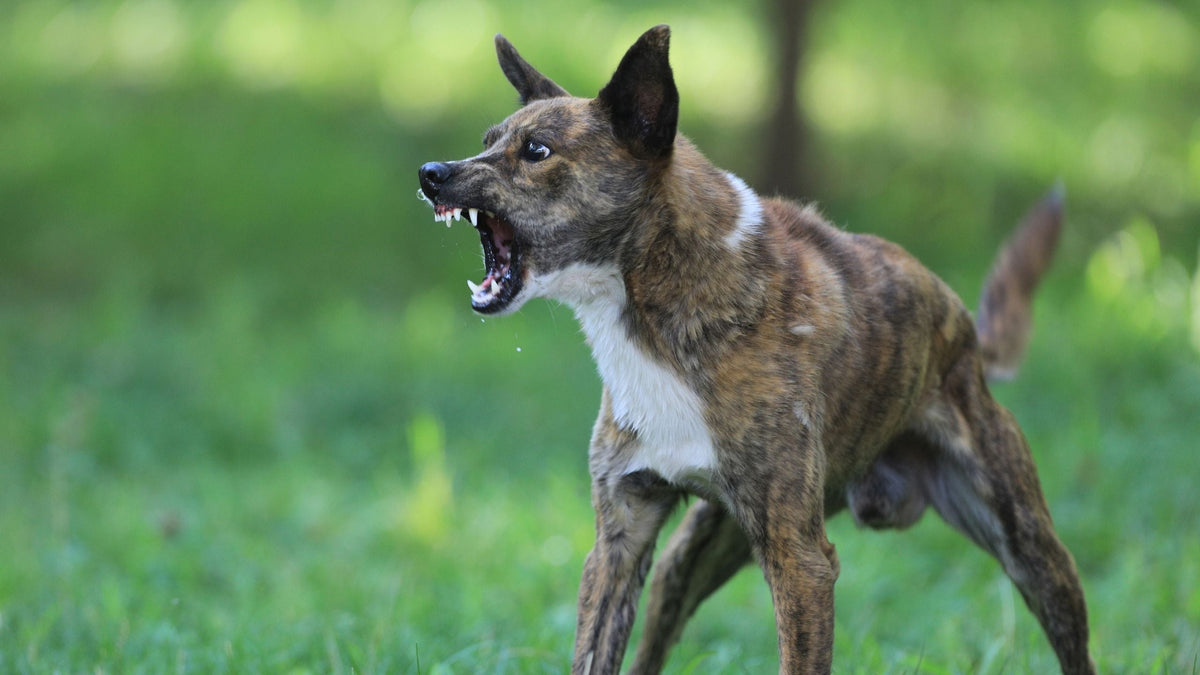
Fear-based aggression is one of the most important topics of all — and probably the most frequently misunderstood. A dog who feels threatened is often not trying to dominate, but to create distance. Growling, barking, snapping, or defensive movement toward a trigger can serve exactly this purpose. This is especially true for dogs who have had negative experiences, struggle to assess stimuli, or live under ongoing tension.
This is one of the biggest misconceptions in everyday life: many people interpret forward-directed behavior as confidence, even though it can actually be an expression of insecurity. A dog who approaches the Leash with an upright tail, assessing the situation, and barks loudly at the other dog may appear confident — but very often is not. Responding to these dogs with additional pressure often increases the very inner conflict that is driving the behavior.
Pain and physical discomfort
In practice, pain is massively underestimated — perhaps the most commonly overlooked cause of aggression overall. A dog who avoids touch, reacts aggressively when the Leash is attached, is irritable while lying down, or snaps during certain movement patterns must be taken seriously from a medical perspective. Orthopedic problems, dental pain, otitis, gastrointestinal discomfort, dermatological conditions, or neurological abnormalities can directly influence behavior. And they often do so without the dog obviously limping or yelping.
International research led by Daniel Mills at the University of Lincoln has repeatedly pointed out in recent years that a substantial proportion of aggressive or reactive dogs have undetected pain conditions. In their case summaries, the proportion of pain-associated behavioral issues is around one third of all cases referred to behavioral medicine — and probably higher, because many sources of pain are subtle and go unnoticed without targeted examination. That is exactly why our rule is clear: in cases of sudden or unusual aggression, medical assessment belongs at the beginning of the process, not at the end. Training without differential diagnostics is not diligence here, but risk.
Resource guarding
Resource guarding is not automatically a sign of a poor relationship. For dogs, food, resting places, toys, social closeness, or even paths and spaces can be relevant. If a dog has learned that approach means loss, the likelihood of defensive behavior increases. This is functionally understandable, even if it can become dangerous in everyday life.
The solution is rarely harshness. It is usually found in management, structured training, fair approaches, and the question of how we create predictability. If resource guarding is only punished, visible warning behavior can be suppressed without solving the problem. In the worst case, the dog learns: warning is not worthwhile — snapping right away might be.
Frustration and overarousal
Not every form of aggression is fear or pain. Some dogs develop aggressive patterns when they repeatedly enter a state they can no longer regulate well themselves. Frustration on the Leash, built-up expectation, lack of impulse control, or persistently high arousal can cause behavior to shift. Research by McPeake and colleagues shows that frustration in dogs is physiologically measurable — including through increases in cortisol — and is not simply “acting up.”
Dogs like this often do not need a harsher tone, but better structure: less overstimulation, clearer criteria, a more refined reward setup, and significantly more training in self-regulation. With our own Amalia, who came to us at six months old, this was exactly one of the central topics — not because she was “bad,” but because she came with a level of arousal that could have shifted into problematic patterns without careful structure.
What research really says about breed, genetics, and aggression
Hardly any topic is as strongly distorted in public as the link between breed and aggression. In a household with restricted breed dogs like ours — Vito as an AmStaff, Amalia as an APBT — this is part of everyday life. The scientific picture is clearly more nuanced than public debate suggests.
Breed explains only a small part of behavior
The much-cited 2022 study by Morrill and colleagues in Science, which examined the behavior of more than 18,000 dogs, reaches a conclusion that challenges many public assumptions: breed explains only around nine percent of the behavioral variation between individual dogs. In other words, more than 90 percent of what makes a dog individual lies outside breed — in genetics within the breed, learning history, early experiences, environmental conditions, health, and the relationship with their humans.
This does not make breed irrelevant. But it equally disqualifies statements such as “this breed is aggressive” or “this breed is harmless.” Current reviews on the genetics of aggression — including several papers in Animals (MDPI) — describe aggressive behavior as a polygenic trait: many genes, each with a small effect, strongly modulated by environment, experience, and physiological state. There is no single “aggression gene.” Reading a breed as a monolithic risk profile is not scientifically defensible.
What this means for restricted breed dogs
For us as a household with two restricted breed dogs, this is more than theory. It means we read our dogs as individuals, not through a breed label. Vito and Amalia each have their own learning histories, their own sensitivities, their own strengths. But it also does not mean that breed plays no role. Certain tendencies — such as conflict with other dogs, high arousal, or specific prey responses — are more pronounced in some lines. Responsible ownership means taking both seriously: the individual in front of us and the characteristics of the line they come from. Generalizing in either direction is unfair — to the dog and to safety.
Why the question of blame often misses the point
Of course, dog owners carry responsibility. They need to organize management, training, and, where necessary, veterinary or behavioral medicine assessment. But responsibility is not the same as reflexively assigning blame. If you judge behavior only in moral terms, you miss the factors that could actually be changed.
The question of blame often leads in two unhelpful directions. Either the dog is labeled a “dog with behavioral challenges,” or the person is broadly made out to be the cause. Both block proper analysis. A much more helpful question is: Which conditions are maintaining this behavior, and which of them can we change fairly?
Why harshness and punishment are so often the wrong response
When it comes to aggression, people understandably react emotionally. The problem is that emotional pushback often intensifies behavior. If you override growling, punish warning signals, or systematically ignore a dog’s need for distance, you do not remove the dog’s motivation. You only take away their ways of expressing it. That can make things more dangerous, not safer.
Here, the research is encouragingly clear. The study by Hiby and colleagues from 2004 (Animal Welfare) was one of the first large comparisons of different training methods and showed that punishment-based methods correlate with significantly more problem behavior — including aggression. The later systematic review by Ziv 2017 (Journal of Veterinary Behavior) confirms this line of evidence: aversive methods increase stress, damage the human-dog relationship, and are not superior to positive reinforcement in effectiveness — on the contrary. When aggression is met with pressure, the problem is statistically more likely to become worse, not better.
This is especially dangerous in multi-dog households, around children, or with insecure dogs. Because a dog that has learned that warning is not allowed may eventually respond more directly — without warning.
What We Need Instead
Clean aggression work is not built on a trick, but on a system. This includes distance management, trigger analysis, safety rules, honest expectation setting, and a training plan that fits the dog’s real motivation. It also requires the willingness to take time. Aggression rarely develops overnight — and it rarely resolves in a weekend seminar.
Management Is Not Failure
Many people hear management and immediately think of giving up. For us, the opposite is true. Good management decisions first create the foundation that makes learning possible. If a dog is constantly living above its threshold, it is not training. It is reacting. And every reaction reinforces the pattern.
That is why tools such as leash handling, muzzle training, spatial separation, visitor management, or planned distance do not belong in the category of “last resort,” but in the category of “professional responsibility.” A well-fitting muzzle is not a stigma. It is one of the most honest safety decisions a dog owner can make.
Training Requires Precision, Not Ideology
Depending on the motive, the training steps differ significantly. Fearful dogs need different processes than dogs that defend resources. Pain cases need diagnostics first. Dogs with frustration often need impulse control and relief. That is why we are cautious about blanket quick fixes. When someone treats aggression the same way every time, they are usually working more with ideology than with analysis.
Here, we rely on training that builds behavior in small steps, takes arousal seriously, and offers the dog alternative strategies. It is not spectacular, but it is reliable. And it is what serious behavioral medicine — from Karen Overall to current European research — has consistently recommended for years.
When external help is truly necessary
There are cases in which dog owner work alone is not enough. If aggression appears suddenly, if bite incidents have occurred, if children or other animals live in the household, or if the dog is under chronic tension, the issue belongs in qualified hands: with a veterinary behaviorist, a thoroughly trained behavior therapist, or both working together. Getting help early is not failure — it is the fairest decision for the dog.
Our Vitomalia conclusion
For us, aggression is not a final judgment about a dog. It is a warning signal. It shows that something in the system is not right: in perception, in stress load, in health status, in learning history, or in environmental organization. When you take this signal seriously, you have the chance to act more fairly and more effectively.
Research gives us a clear framework for this. Aggression is polygenic, context-dependent, and strongly shaped by the environment. Breed explains only a small part. Fear is often the root — in around 43 percent of reactive cases. Pain is the most commonly overlooked cause. Punishment-based methods statistically worsen the picture rather than resolve it. And individualized, carefully structured training that takes motive and function seriously is the most scientifically robust path.
When aggression is read only as disobedience or bad intent, the real issue is often missed. That is exactly why our standard is not harshness, but precision: look closely, assess thoroughly, build training appropriately, and never confuse warning behavior with character flaws. This applies to every dog — from a rescue mixed breed to a restricted breed dog from responsible breeding. Understanding behavior instead of judging it — that is the only path that truly helps both dog and dog owner move forward.